
16.10.2026. Bogotá
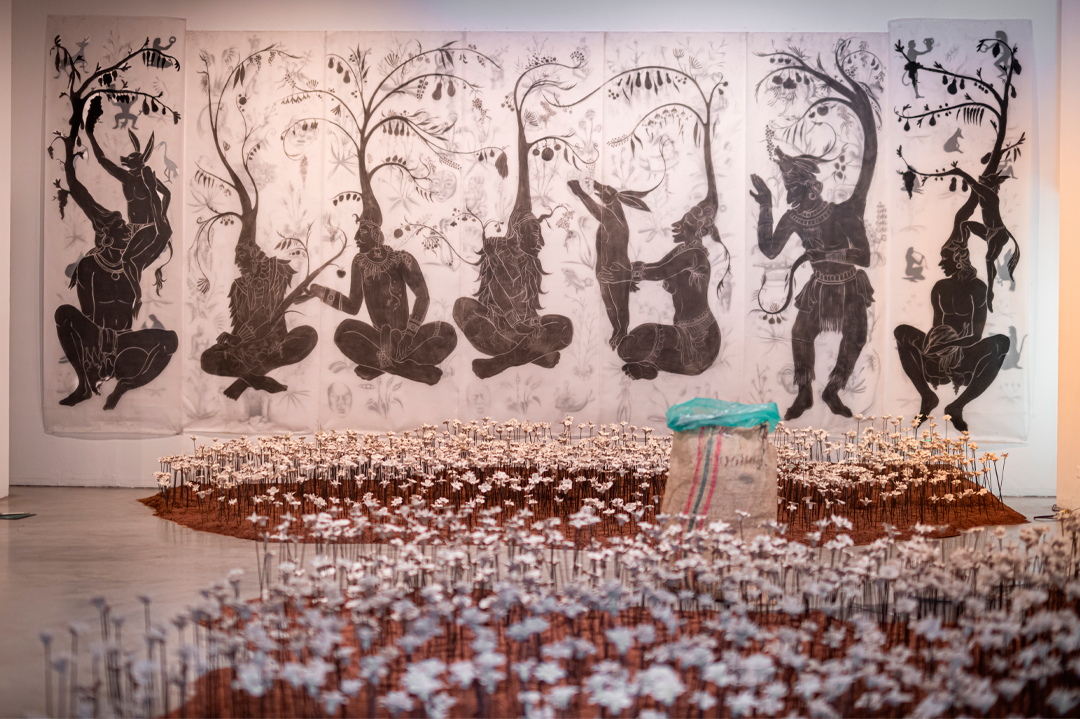
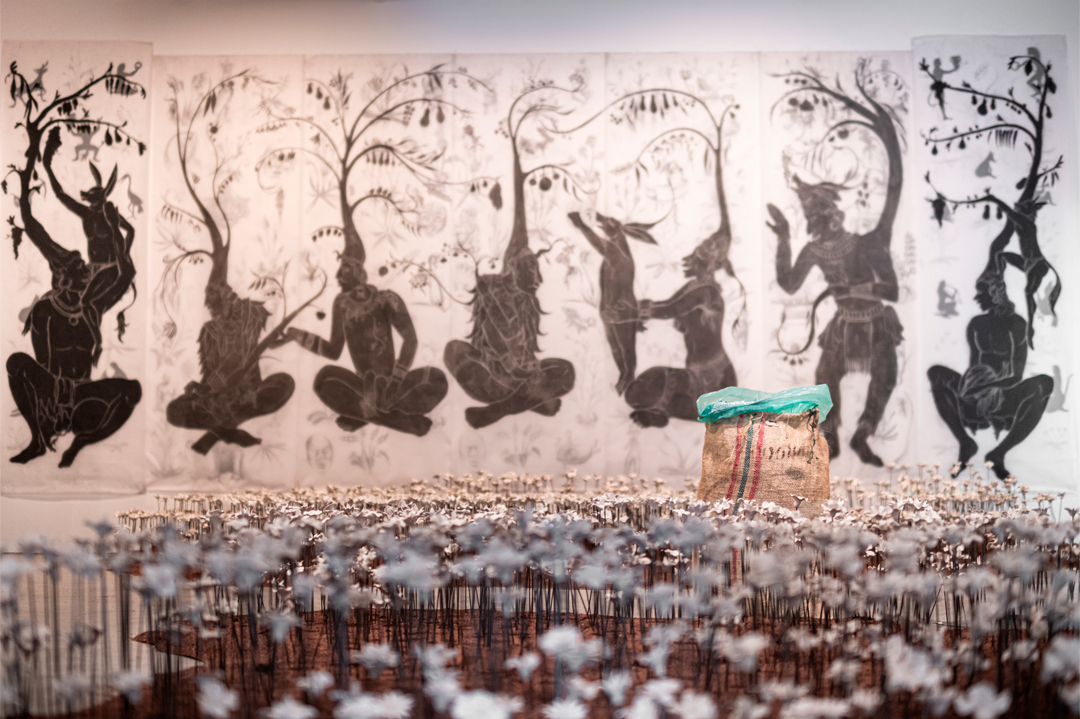
Una flor blanca sobre un tallo finísimo puede pasar inadvertida. Repetida 10.800 veces, transforma una sala en un paisaje que invita a cuestionarse. En El país de Nunca Jamás, Diego Cibelli reúne miles de flores de porcelana hechas a mano sobre un sustrato oscuro del que emana un intenso olor a cacao. El jardín ocupa el centro de NC arte y despliega una escena de delicadeza y abundancia, donde cada pieza conserva su singularidad dentro de un conjunto que parece extenderse como una pequeña vegetación fantástica.
Curada por Eugenio Viola, esta primera exposición individual del artista italiano en América Latina fue concebida específicamente para el espacio. La intervención comienza en la fachada, con figuras difíciles de clasificar que asoman por las ventanas y anuncian una alteración del orden cotidiano. Desde ese primer encuentro, el edificio se convierte en el umbral de un mundo con sus propias criaturas, ritmos y formas de convivencia. En el interior, dibujos de gran formato envuelven la sala y acompañan la aparición de la isla-jardín.
A white flower on an exceptionally slender stem can go unnoticed. Repeated 10,800 times, it transforms a room into a landscape that invites reflection. In El país de Nunca Jamás, Diego Cibelli brings together thousands of handmade porcelain flowers set upon a dark substrate from which an intense scent of cocoa emanates. The garden occupies the center of NC arte, unfolding into a scene of delicacy and abundance, where each piece retains its singularity within a whole that seems to spread like a small, fantastical vegetation.
Curated by Eugenio Viola, this first solo exhibition by the Italian artist in Latin America was conceived specifically for the space. The intervention begins on the façade, with figures that defy classification peering through the windows and announcing a disruption of everyday order. From this first encounter, the building becomes the threshold to a world with its own creatures, rhythms, and forms of coexistence. Inside, large-format drawings envelop the room and accompany the emergence of the island-garden.
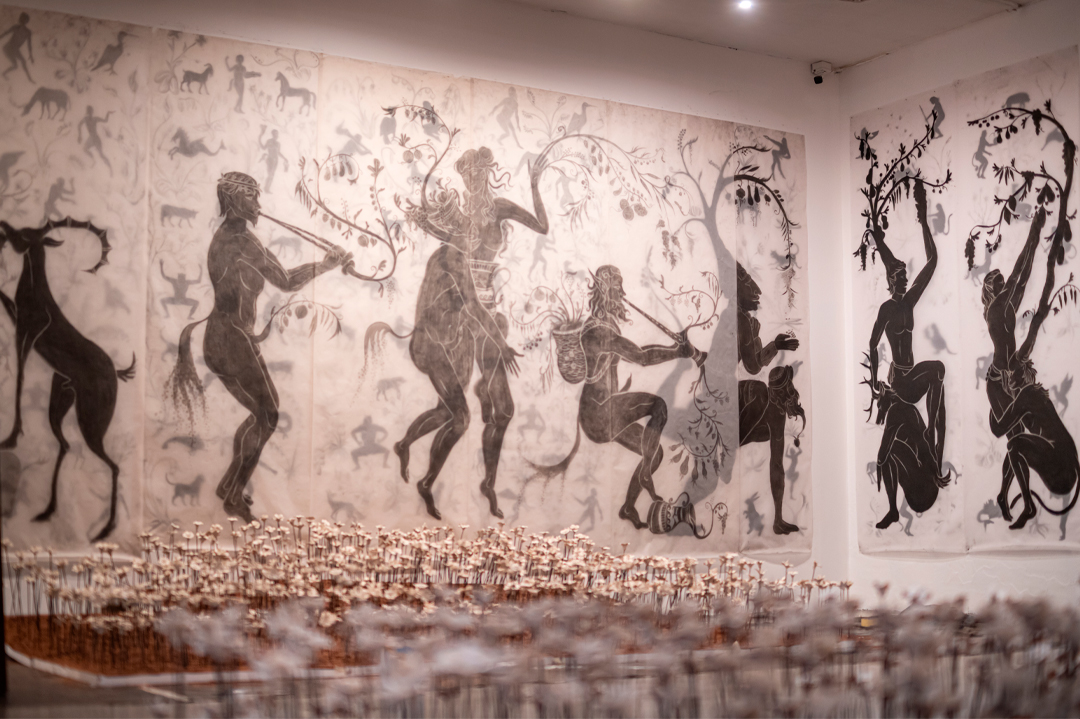
La relación entre ambos elementos construye buena parte del encanto de la exposición. En las paredes, cuerpos humanos, animales y formas vegetales se entrelazan hasta volver inciertos sus límites. Algunas figuras levantan los brazos hacia ramas cargadas de frutos; otras se sientan, se contorsionan o parecen prolongarse en árboles. Sus siluetas oscuras contrastan con la blancura de las flores, mientras los trazos más tenues del fondo multiplican las presencias. La escena puede hablarnos de un relato abierto, como si cada gesto perteneciera a una genealogía más amplia frente a la cual aún podemos disponernos a imaginar.
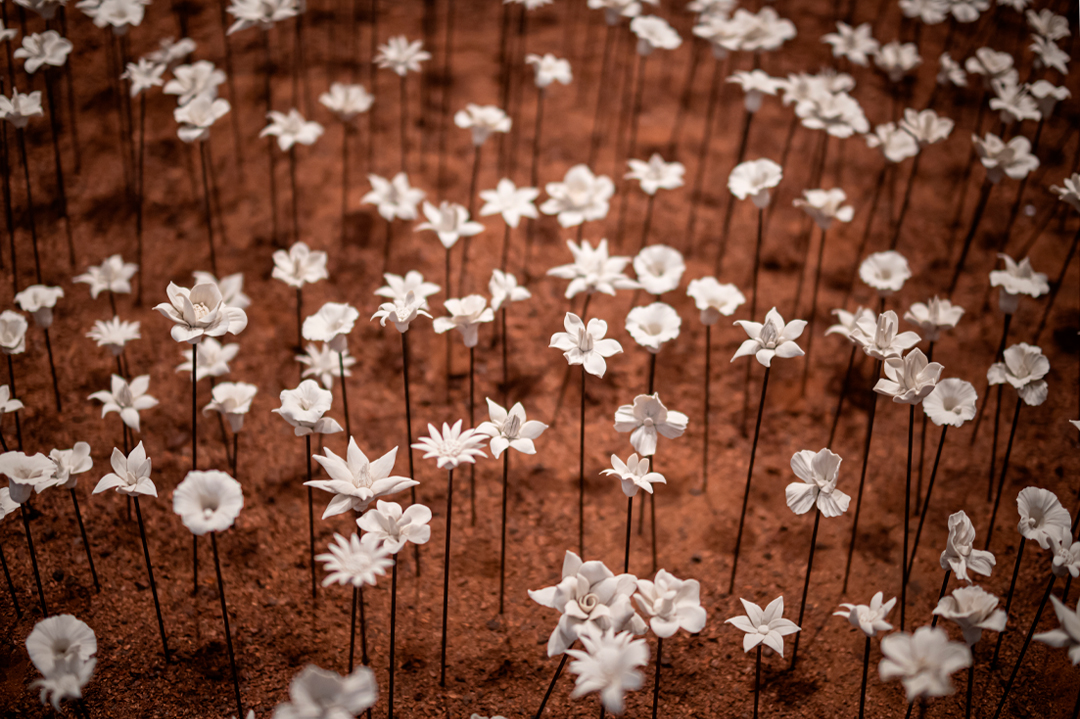
En ese universo de cuerpos expansivos, las flores introducen otra escala. Sus tallos finos sostienen pétalos, puntas y pequeños volúmenes que reclaman una mirada cercana. A distancia, el jardín se percibe como una superficie continua; al aproximarse, aparecen las diferencias entre sus formas. El recorrido oscila entre esas dos maneras de mirar, entre la impresión de un paisaje y la atención a una pieza diminuta. La repetición produce un ritmo, pero deja suficiente espacio para entrar.
The relationship between these two elements accounts for much of the exhibition’s appeal. On the walls, human bodies, animals, and vegetal forms intertwine until their boundaries become uncertain. Some figures raise their arms toward branches laden with fruit; others sit, contort their bodies, or seem to extend into trees. Their dark silhouettes contrast with the whiteness of the flowers, while the fainter lines in the background multiply their presences. The scene suggests an open-ended narrative, as though each gesture belonged to a broader genealogy that invites us to imagine what might lie beyond it.
Within this universe of expansive bodies, the flowers introduce a different scale. Their slender stems support petals, pointed forms, and small volumes that demand a closer look. From a distance, the garden appears as a continuous surface; up close, differences between its forms begin to emerge. The experience shifts between these two ways of looking, between the impression of a landscape and the attention given to a tiny object. Repetition establishes a rhythm while leaving enough space for us to enter.
El título toma prestado el territorio imaginario de Peter Pan, la isla creada por J. M. Barrie y asociada con la infancia, la suspensión del tiempo y el deseo de escapar de las reglas de la realidad. Cibelli recoge esa promesa y se detiene en sus ambivalencias. Incluso un lugar inventado tiene condiciones de acceso, formas de pertenencia y posibilidades de exclusión. La fantasía abre así una pregunta bastante concreta sobre quién puede entrar en un paraíso y qué cuerpos encuentran un lugar dentro de él.
Esa inquietud recorre el paisaje sin quitarle su capacidad de seducción. Las criaturas híbridas permiten imaginar identidades que se modifican mediante el contacto con otras formas de vida. Las ramas brotan de los cuerpos, los rasgos animales alteran las siluetas y la vegetación participa de sus movimientos. En ese mundo, la figura humana comparte protagonismo con organismos que desobedecen las clasificaciones habituales y Cibelli pone en juego una convivencia hecha de cruces, dependencias y transformaciones.
The title borrows from the imaginary territory of Peter Pan, the island created by J. M. Barrie and associated with childhood, the suspension of time, and the desire to escape the rules of reality. Cibelli embraces this promise while dwelling on its ambiguities. Even an invented place has conditions of access, forms of belonging, and possibilities for exclusion. Fantasy thus opens up a rather concrete question: who gets to enter paradise, and which bodies find a place within it?
This unease runs through the landscape without diminishing its power to seduce. The hybrid creatures allow us to imagine identities that change through contact with other forms of life. Branches sprout from bodies, animal features alter silhouettes, and vegetation participates in their movements. In this world, the human figure shares the spotlight with organisms that defy conventional classifications, as Cibelli explores a form of coexistence shaped by crossings, dependencies, and transformations.
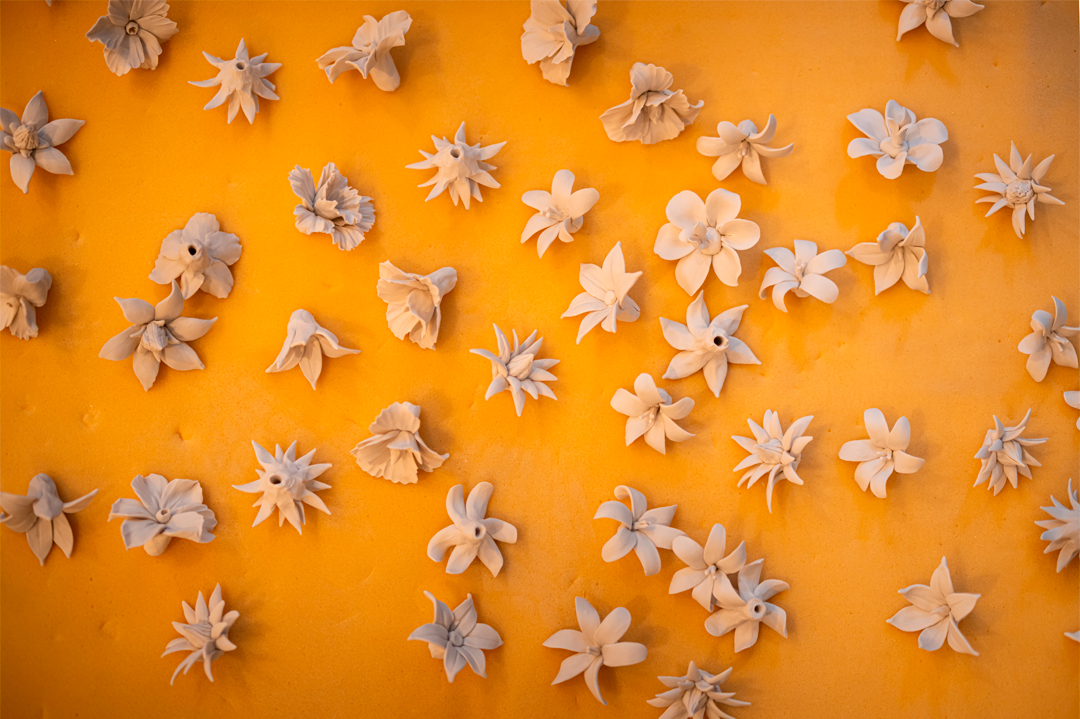
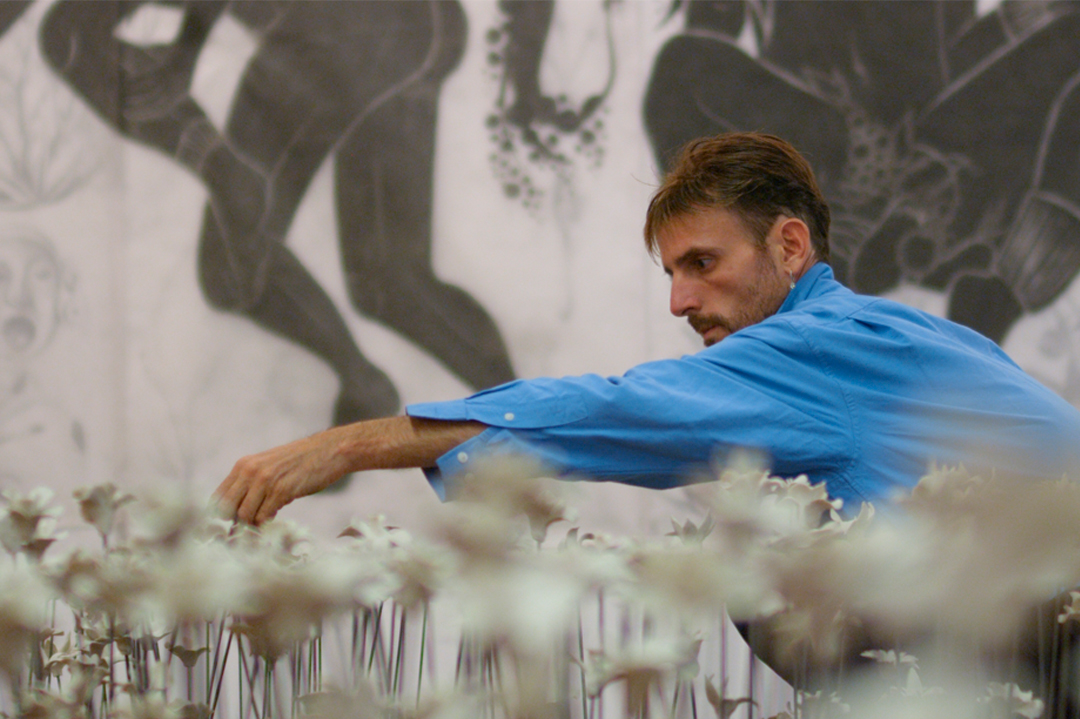
La porcelana introduce una tensión especialmente fértil en esta escena. La exuberancia del jardín está construida con un material delicado, y el cuidado que exige cada flor acompaña la percepción del conjunto. Saber que las 10.800 piezas fueron hechas a mano e instaladas una a una permite imaginar el tiempo acumulado en ese paisaje. Su escala monumental nace de una sucesión de gestos pequeños, pacientes, atentos a las particularidades de cada forma.
Ese vínculo entre materia, memoria y trabajo artesanal ocupa un lugar central en la práctica del artista. Nacido en Nápoles en 1987 y formado entre su ciudad natal y Berlín, Cibelli desarrolla una investigación sobre los territorios y las maneras en que construimos pertenencia a través de los objetos, los espacios y el paisaje. La cerámica y la porcelana biscuit le permiten reunir tradición artesanal, imaginarios populares, artes decorativas e historia del gusto en instalaciones, esculturas y dibujos. En esta exposición, ese repertorio encuentra una dimensión envolvente, capaz de alojar al visitante dentro de sus asociaciones.
Porcelain introduces a particularly fertile tension into this scene. The garden’s exuberance is constructed from a delicate material, and the care required to make each flower becomes part of our perception of the whole. Knowing that all 10,800 pieces were handmade and installed one by one allows us to imagine the accumulated time embodied in this landscape. Its monumental scale emerges from a succession of small, patient gestures, each attentive to the particularities of its form.
This relationship between material, memory, and artisanal labor occupies a central place in the artist’s practice. Born in Naples in 1987 and trained between his hometown and Berlin, Cibelli investigates territories and the ways in which we construct belonging through objects, spaces, and landscapes. Ceramics and biscuit porcelain allow him to bring together artisanal traditions, popular imaginaries, decorative arts, and the history of taste in installations, sculptures, and drawings. In this exhibition, these elements take on an immersive dimension, drawing visitors into a network of associations.
Sus referencias se desplazan entre las mitologías preclásicas y las estructuras efímeras de la fiesta barroca. Esa relación con lo escenográfico resulta sugerente en un espacio donde la arquitectura, el dibujo y la escultura participan de una misma atmósfera. El interior conserva, además, las huellas de una acción previa, como si un ritual hubiera ocurrido antes de nuestra llegada. La exposición deja abierta esa sensación de entrar en una escena que ya estaba en marcha, con una historia anterior a nuestra presencia.
El cacao incorpora otra manera de acercarse al jardín. Su olor da una dimensión física al paisaje y acompaña la mirada con una experiencia que se expande por la sala. La blancura de las flores, la oscuridad del sustrato y las figuras que recorren las paredes construyen un entorno donde los sentidos se encuentran. La fantasía de Cibelli adquiere textura, aroma y escala; se vuelve un lugar ante el cual el cuerpo también debe situarse.
His references move between pre-Classical mythologies and the ephemeral structures of Baroque festivities. This relationship with the theatrical and the scenographic is particularly evocative in a space where architecture, drawing, and sculpture contribute to a shared atmosphere. The interior also retains traces of a prior action, as though a ritual had taken place before our arrival. The exhibition leaves open the feeling of entering a scene already in progress, one with a history that precedes our presence.
Cocoa offers another way of approaching the garden. Its scent lends the landscape a physical dimension, accompanying the act of looking with an experience that expands throughout the room. The whiteness of the flowers, the darkness of the substrate, and the figures that traverse the walls create an environment in which the senses converge. Cibelli’s fantasy acquires texture, aroma, and scale; it becomes a place in which the body, too, must find its position.
Entre la minuciosidad de las flores y la libertad de sus criaturas, El país de Nunca Jamás sostiene una pregunta sobre el cuidado. ¿Cómo compartir un espacio con presencias distintas a la propia? La exposición se acerca a esa inquietud desde el asombro, dejando que la belleza del jardín despierte atención hacia sus vínculos y su vulnerabilidad. Su mundo imaginario ofrece una pausa desde la cual observar nuestros hábitos de pertenencia y las condiciones que imponemos a quienes conviven con nosotros.
El país de Nunca Jamás, de Diego Cibelli, podrá visitarse hasta el 19 de diciembre de 2026 en NC arte, Bogotá.
Between the meticulous detail of the flowers and the freedom of its creatures, Neverland sustains a question about care. How can we share a space with presences different from our own? The exhibition approaches this concern through wonder, allowing the garden’s beauty to awaken an awareness of its relationships and vulnerability. Its imaginary world offers a pause from which to observe our habits of belonging and the conditions we impose on those who coexist with us.
El país de Nunca Jamás, by Diego Cibelli, will be on view until December 19, 2026, at NC arte, Bogotá.