
20.11.2025. NYC
Este texto está escrito a dos voces: la primera parte por Andrea Muñoz (AM) y la segunda por pablo guarín robledo (pgr).
This text is written in two voices: the first part by Andrea Muñoz (AM) and the second by pablo guarín robledo (pgr).
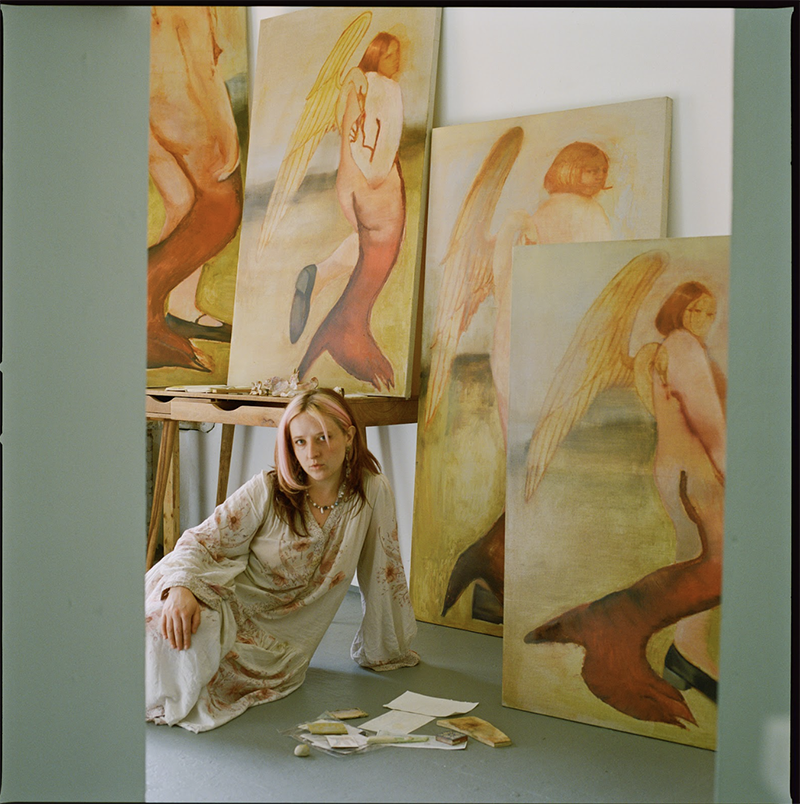
Manuela Caicedo (Bogotá, 1993) es una artista visual egresada del pregrado en Artes Visuales de la Pontificia Universidad Javeriana y el MFA con concentración en pintura de la New York Academy of Art, donde recibió la prestigiosa Chubb Fellowship. Su práctica, situada entre la pintura, el objet trouvé, la carpintería intuitiva y la instalación, indaga en la potencia imaginativa de la mirada y en el modo en que la materialidad constituye una forma de pensamiento. En obras recientes como Las Dragonas, su trabajo se despliega como un laboratorio de transmutaciones: de la forma, del gesto, del fuego y del sueño.
Manuela Caicedo (Bogotá, 1993) is a visual artist who holds a BFA in Visual Arts from Pontificia Universidad Javeriana and an MFA with a concentration in Painting from the New York Academy of Art, where she received the prestigious Chubb Fellowship. Her practice, situated between painting, objet trouvé, intuitive carpentry, and installation, explores the imaginative power of looking and the ways in which materiality becomes a form of thought. In recent works such as Las Dragonas, her practice unfolds as a laboratory of transmutations: of form, gesture, fire, and dream.
Texto por Andrea Muñoz (AM)
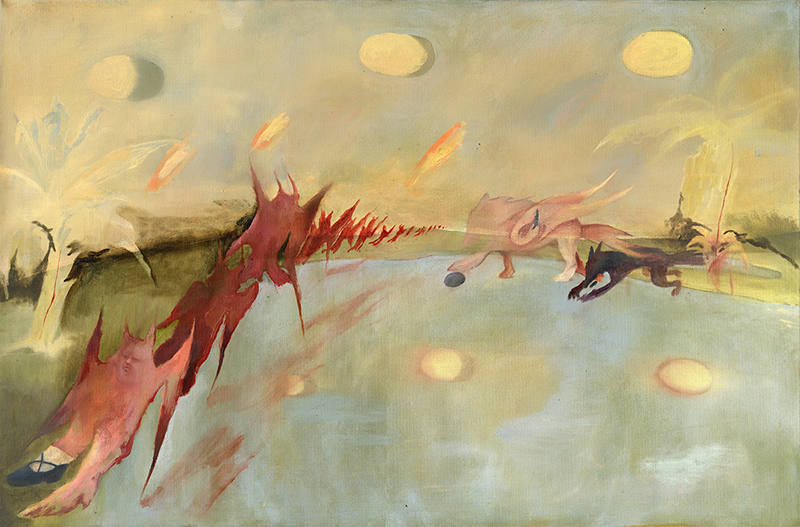
Este no es un escrito que pretenda revelar nada, al contrario, es un intento, quizás necesario, quizás fallido, de caminar alrededor de un secreto que no debe ser revelado sino apenas vislumbrado. Se trata de Las Dragonas, la serie de pinturas de la artista bogotana Manuela Caicedo, una obra que nació en el 2024 durante su maestría en pintura en la New York Academy of Art y que ha continuado hasta el 2025.
This is not a text that seeks to reveal anything; on the contrary, it is an attempt—perhaps necessary, perhaps doomed—to walk around a secret that should not be revealed, only barely glimpsed. It is about Las Dragonas, the series of paintings by Bogotá-based artist Manuela Caicedo, a body of work born in 2024 during her MFA in Painting at the New York Academy of Art and continued into 2025.
Caicedo no pinta para explicar, sus obras no ilustran una idea cerrada. Ella, como una maga silenciosa, convoca imágenes desde un lugar que no sabemos si pertenece al mundo de los sueños o al de la vigilia. Y es que en su caso, ambas dimensiones parecen tocarse. El punto de partida de esta historia podría ser una de las piezas más reveladoras de Caicedo, la pintura de un volcán en erupción de seis metros de ancho. Lo pintó casi en trance, en un estado de cansancio permanente. El volcán no fue solo un motivo pictórico, sino un acto de transmutación de la imaginación a la imagen. El cansancio de la artista durante su ejecución, relata su camino y encuentro con el fuego creador.
Caicedo does not paint to explain; her works do not illustrate a closed idea. Like a silent magician, she summons images from a place we cannot tell belongs to dream or to wakefulness. In her case, both dimensions seem to touch. The starting point of this story could be one of Caicedo’s most revealing pieces: a six-meter-wide painting of an erupting volcano. She painted it almost in a trance, in a state of constant exhaustion. The volcano was not just a pictorial motif but an act of transmuting imagination into image. The artist’s fatigue during its execution traces her path and encounter with the creative fire.
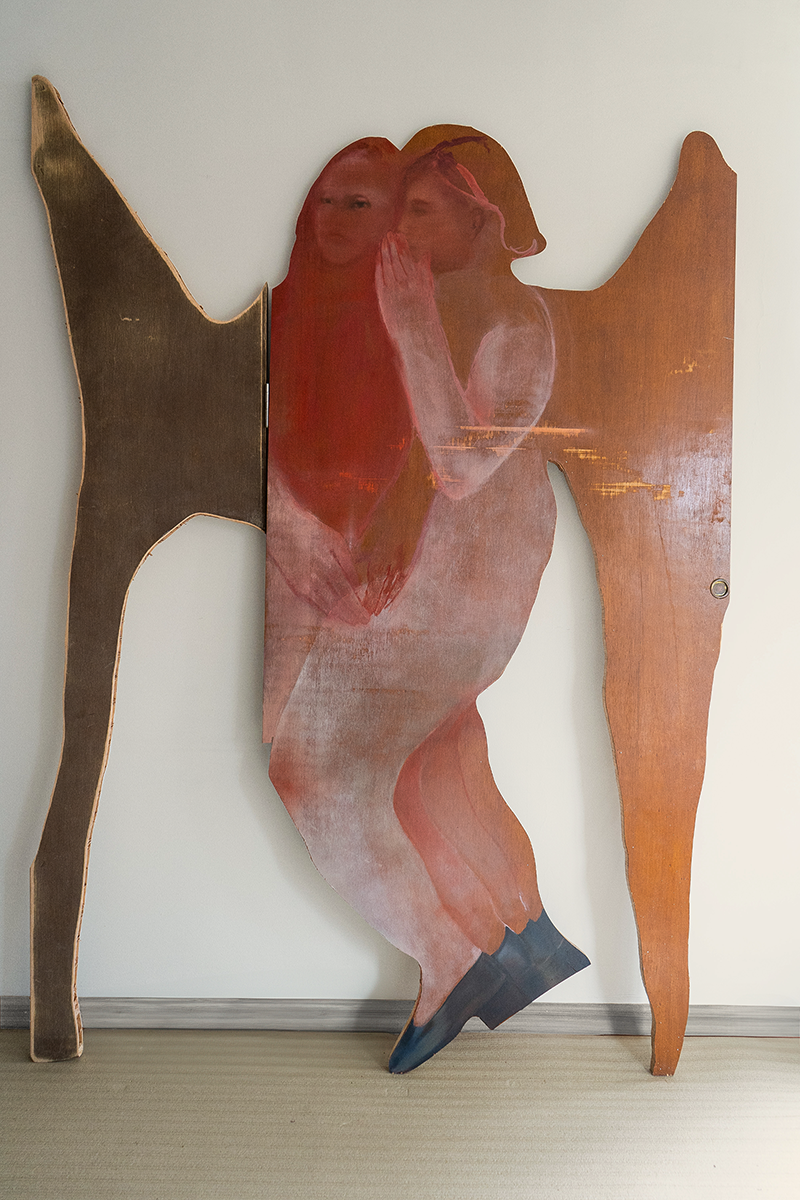
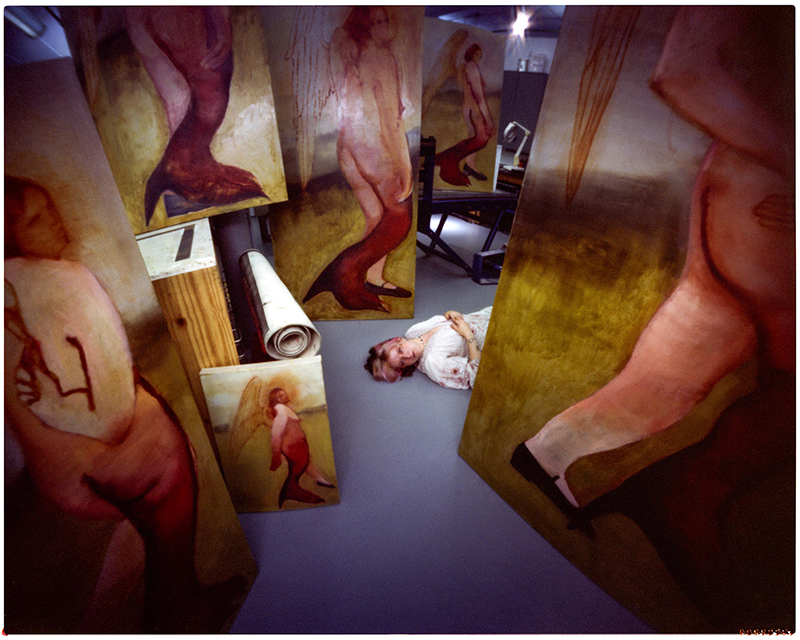
De ese volcán, surgió lo que vendría después: un Pegaso, y de algunos fragmentos no usados de la materialidad de este ser mitológico, comenzaron a surgir Las Dragonas. ¿Qué son? Difícil decirlo. No son seres figurativos ni mitológicos en sentido estricto. Son entidades que emergieron primero como formas sugeridas en materiales residuales, cortes de madera, fragmentos que parecían órganos dispersos esperando ser convocados a un cuerpo. La artista, creadora o médium, los reunió, los pintó, les dio volumen y fuerza, y de pronto se sostuvieron de pie como si se hubieran levantado no solo del suelo, sino del sueño.
From that volcano, what came next began to emerge: a Pegasus, and from the unused fragments of this mythological being’s materiality, Las Dragonas started to appear. What are they? Hard to say. They are neither figurative nor mythological beings in a strict sense. They are entities that first emerged as suggested forms within leftover materials—cuts of wood, fragments that looked like scattered organs waiting to be summoned into a body. The artist, creator or medium, gathered them, painted them, gave them volume and force, and suddenly they could stand upright as if rising not only from the floor but from a dream.
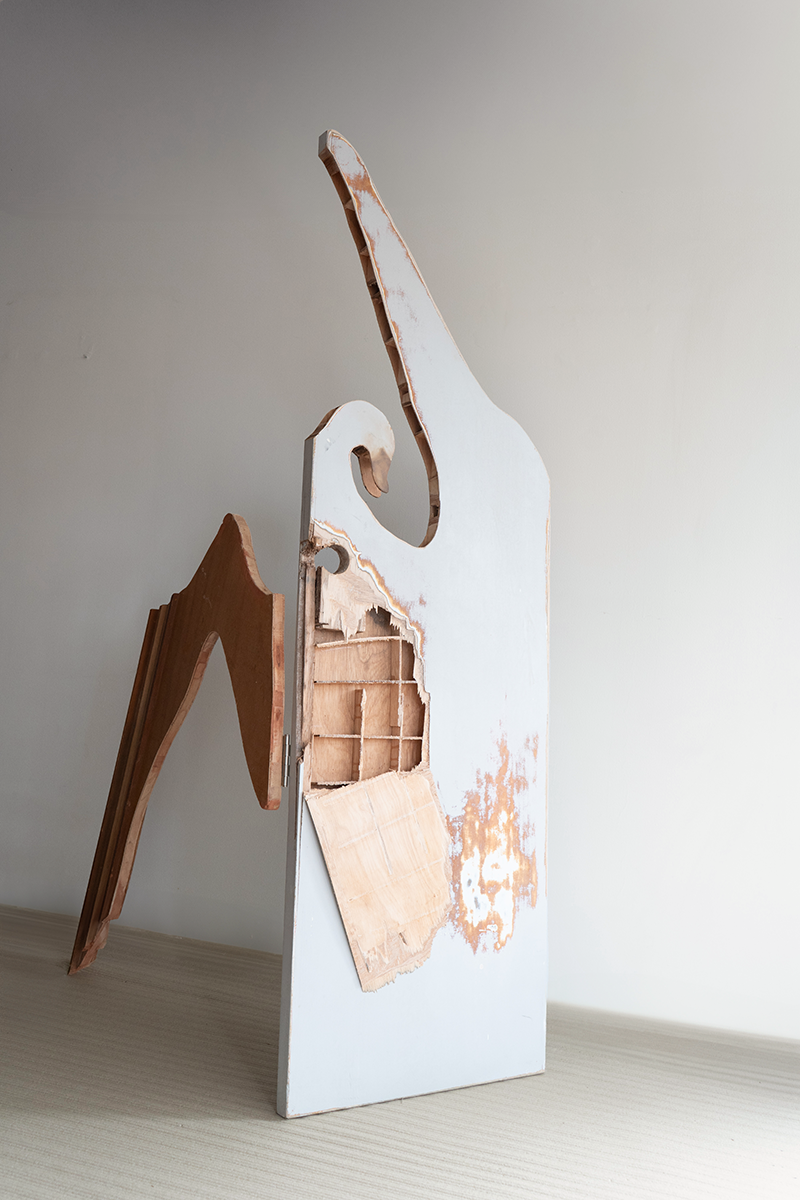
Las Dragonas no fueron diseñadas, fueron reconocidas como si ya existieran en alguna dimensión oculta. Las Dragonas son en cierto sentido locuras, no porque sean absurdas, sino porque renuncian al control racional. Son el resultado de ralentizar el acto de nombrar, de permitir que las formas permanezcan abiertas, infinitas. Son también el resultado de una profunda entrega al misterio y a la intuición, al fuego interior que ilumina lo que no puede ser explicado. De allí que esta serie también encarne una fuerza femenina ancestral.
Las Dragonas were not designed; they were recognized, as if they already existed in some hidden dimension. They are, in a sense, madnesses—not because they are absurd, but because they renounce rational control. They are the result of slowing down the act of naming, of allowing forms to remain open, infinite. They are also the outcome of a profound surrender to mystery and intuition, to the inner fire that illuminates what cannot be explained. This is why the series also embodies an ancestral feminine force.
Las Dragonas nos conectan con algo antiguo, primitivo, que vive en lo más profundo de nuestra conciencia. Quizás hoy, en un mundo hipercontrolado por lo superficial, por cierta idea de lo racional y la inteligencia artificial, revisar el significado de los sueños sea un acto urgente, porque allí se esconde una tecnología distinta, una tecnología divina. Allí está el lugar secreto donde se encuentra el fuego creador de todos los tiempos.
Las Dragonas connect us to something ancient, primitive, living deep within our consciousness. Perhaps today, in a world hyper-controlled by the superficial, by a certain idea of rationality and artificial intelligence, revisiting the meaning of dreams is an urgent act, for there we find a different technology—a divine one. There lies the secret place where the creative fire of all times resides.
Texto por pablo guarín robledo (pgr)
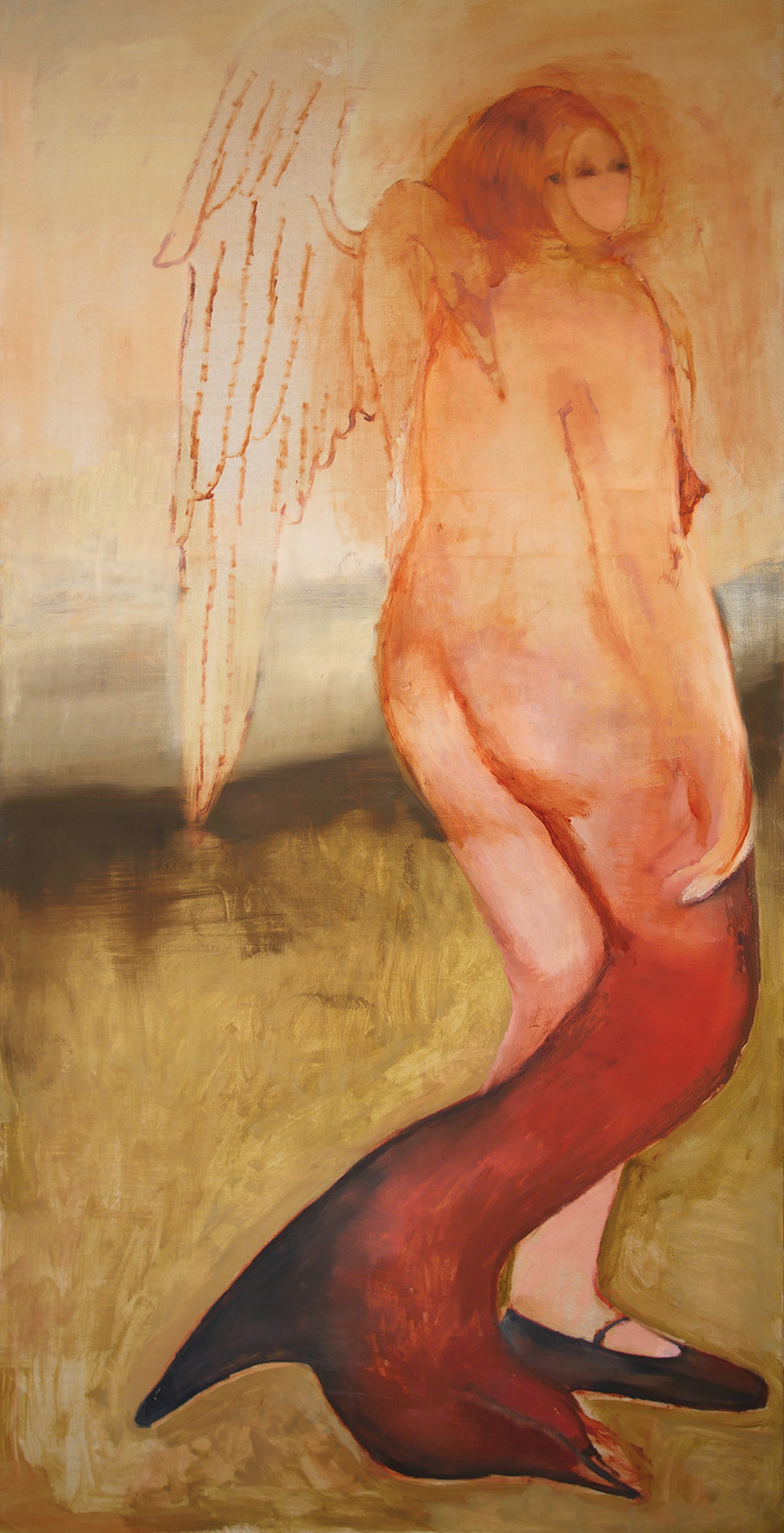
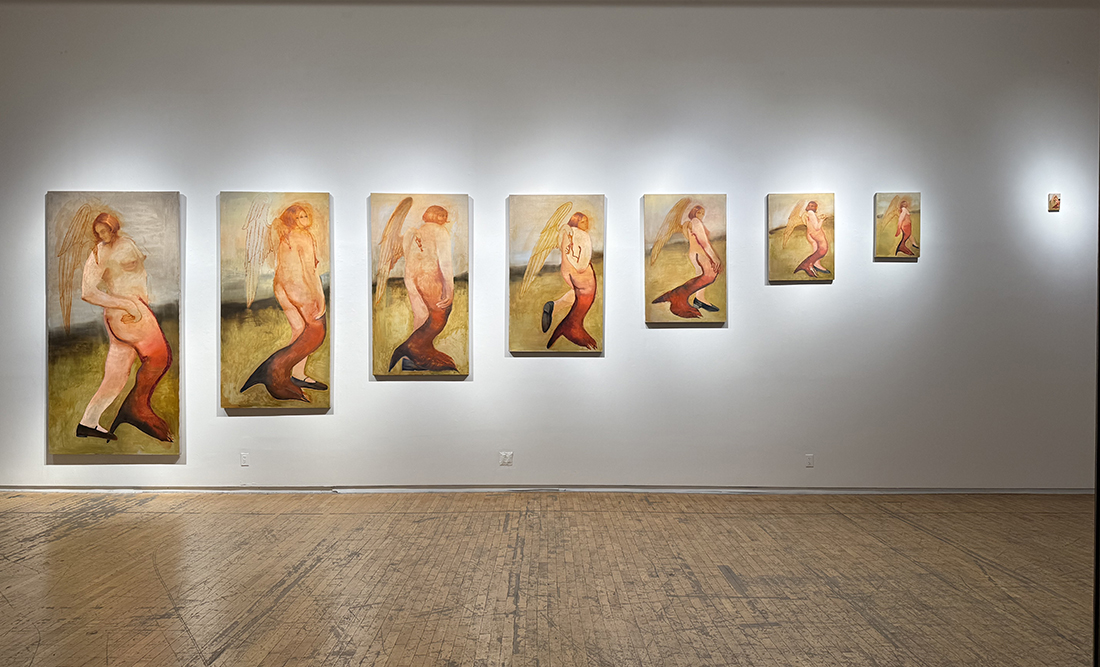
Mitad mujer y mitad monstruos, mitad ella y mitad otras, mitad autorretrato cansado y mitad paisajes arrasados por el fuego, estos seres alados se revelan como las actrices principales del Teatro de la muerte, el proyecto más reciente de Manuela Caicedo, presentado en la New York Academy of Art el pasado septiembre. Ocho pinturas, cada una más pequeña que la anterior, configuran una línea ascendente. Una suerte de escalera invertida, un recorrido cuesta arriba hacia el más allá. La instalación, de manera simple y contundente, deja el juego de la perspectiva al desnudo. Percibimos más pequeño aquello que se aleja: así pasa con las imágenes y así pasa con la muerte.
Half woman and half monster, half herself and half others, half a tired self-portrait and half landscapes devastated by fire—these winged beings reveal themselves as the main actresses of the Theater of Death, Manuela Caicedo’s most recent project, presented at the New York Academy of Art this past September. Eight paintings, each smaller than the last, form an ascending line. A kind of inverted staircase, an uphill ascent toward the beyond. The installation, simple and forceful, lays bare the trick of perspective. We perceive smaller what moves away: this is true of images, and this is true of death.
La imagen se repite con una serie de variaciones mínimas. Cada vez más pequeña, más arriba, más alejada de la vista de los espectadores de este espectáculo mortuorio. Como la niña protagonista de “La legión extranjera”, el cuento de Clarice Lispector, estas dragonas crepitan con la valentía “de nacer de su propio parto y abandonar en el suelo el cuerpo antiguo”. En la primera pintura, si bien uno de los pies de la dragona parece todavía humano, el otro, rojo y desproporcionado como una llama salida de control, le hace zancadilla. La muerte nos hace tropezar con nosotros mismos. Más arriba, como si brotara de uno de sus brazos, un cisne le presta sus alas y se posa sobre su hombro. En la segunda pintura, la cara de la dragona, antes clara, se escinde. Un rostro sobre otro rostro. Una máscara. Una identidad disuelta. A continuación, el pico del cisne se clava en la espalda que antes le servía de posadera y en la siguiente, la otra mano, la todavía humana, se contorsiona y se dirige al pico del cisne. Quizás busca acallar los graznidos antes de torcerle el cuello.
The image repeats with a series of minimal variations. Each time smaller, higher, further from the viewers’ sight in this mortuary spectacle. Like the girl in Clarice Lispector’s story “The Foreign Legion,” these dragonas crackle with the bravery “of being born from their own birth and leaving their old body on the ground.” In the first painting, although one of the dragona’s feet still appears human, the other—red and disproportionate like a flame gone wild—trips her. Death makes us stumble over ourselves. Above, as if sprouting from one of her arms, a swan lends her its wings and perches on her shoulder. In the second painting, the dragona’s face, previously clear, splits. One face over another. A mask. A dissolved identity. Next, the swan’s beak pierces the back that once held it, and in the following painting, her other hand—the still human one—twists toward the swan’s beak. Perhaps she seeks to silence the squawks before breaking its neck.
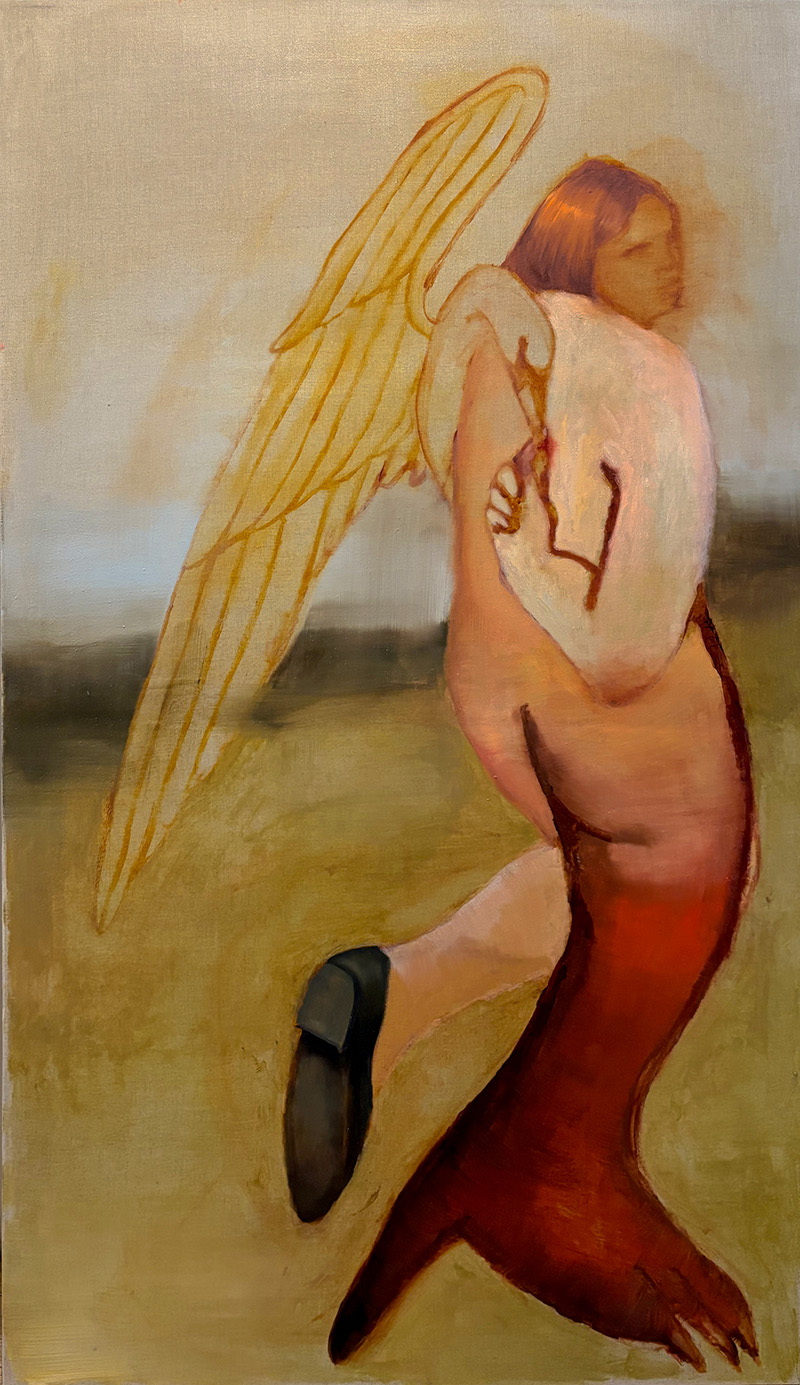
En la quinta pintura, el cisne amenazado renuncia al impulso antropófago y nuevamente parece que la acaricia o que le da un beso a la dragona. En la que sigue, la máscara se cae y la dragona la sostiene en sus manos con la delicadeza de quien sostiene algo frágil, o muerto. Aunque permanece absorta en la máscara, dos ojos nos miran expectantes desde la parte de atrás de su cabeza. Acaso revisita sus versiones pasadas. Acaso se despide de ellas. En la séptima y penúltima, la dragona vuelve otra vez la cabeza hacia atrás, entre el placer y el dolor, entre el amor y la muerte. El brazo y el torso que aún parecían humanos se tiñen de rojo, abrasados por el fuego. La transformación se consuma. El abrazo de la muerte se cierne sobre la dragona.
In the fifth painting, the threatened swan gives up its anthropophagic impulse and once again seems to caress or kiss the dragona. In the next one, the mask falls, and the dragona holds it in her hands with the delicacy of someone holding something fragile—or dead. Though absorbed in the mask, two eyes gaze at us expectantly from the back of her head. Maybe she revisits her past versions. Maybe she bids them farewell. In the seventh and penultimate painting, the dragona turns her head back again—between pleasure and pain, between love and death. The arm and torso that still seemed human turn red, scorched by fire. The transformation is complete. Death’s embrace closes in on her.
Antes de la octava pintura, la más pequeña, el punto de fuga, hay una especie de hiato. Un silencio. Un pedazo de pared vacía lo suficientemente prolongado para que tras las bambalinas se cuele, como un murmullo distante, el eco del fuego creador que se extingue. Una vez más resuenan las palabras de Lispector: “morir es el final de algo fulgurante”. Las pinturas de Manuela Caicedo, a través de la repetición, la superposición de motivos y la proliferación de metáforas, conjuran esas imágenes alumbradas por el misterio incandescente de la muerte.
Before the eighth painting, the smallest one—the vanishing point—there is a kind of hiatus. A silence. A stretch of wall left empty long enough for the backstage to seep in, like a distant murmur, the echo of the creative fire as it fades. Once again, Lispector’s words resound: “to die is the end of something fulgurant.” Manuela Caicedo’s paintings, through repetition, the layering of motifs, and the proliferation of metaphors, conjure images illuminated by the incandescent mystery of death.
Sobre los curadores / The curators
Andrea Muñoz (1986)
Maestra en Artes Plásticas de Manizales con más de una década de experiencia en dirección, curaduría y gestión de proyectos de arte contemporáneo. Ha trabajado en espacios como Plural Nodo Cultural (curadora 2019–2022, directora 2023–2024) y desarrollado proyectos para ARTBO | Salas 2025 y HAWAPI (Perú). Actualmente dirige La Joia, plataforma de acompañamiento a artistas emergentes en Colombia.
Visual Arts graduate with over a decade of experience in directing, curating, and managing contemporary art projects. She has worked with spaces such as Plural Nodo Cultural (curator 2019–2022, director 2023–2024) and developed projects for ARTBO | Salas 2025 and HAWAPI (Peru). She currently leads La Joia, a platform supporting emerging artists in Colombia.
pablo guarín robledo (1997)
Es un curador e investigador colombiano cuyo trabajo se centra en la conversación con artistas jóvenes. Su práctica curatorial está orientada a la conceptualización y gestión de primeras exposiciones individuales, así como en el posicionamiento de nuevas voces en las escenas artísticas de Nueva York, Bogotá y Medellín. Su investigación articula imagen en movimiento, arquitecturas de la memoria y estéticas de la interrupción, explorando cómo obras inacabadas y espacios suspendidos abren nuevas formas de narrar el pasado. Es doctorando en el Departamento de Español y Portugués de la Universidad de Princeton y colabora de manera habitual como curador invitado con la galería Policroma.
Pablo Guarín Robledo is a curator and researcher whose work centers on sustained dialogue with young artists. His curatorial practice focuses on the conception and development of first solo exhibitions, as well as on positioning these practices within the artistic scenes of New York, Bogotá, and Medellín. His research weaves together moving image, architectures of memory, and aesthetics of interruption, exploring how unfinished works and suspended spaces open new ways of narrating the past. He is a doctoral candidate in the Department of Spanish and Portuguese at Princeton University and collaborates regularly as a guest curator with Galería Policroma.