
06.04.2026. Medellín
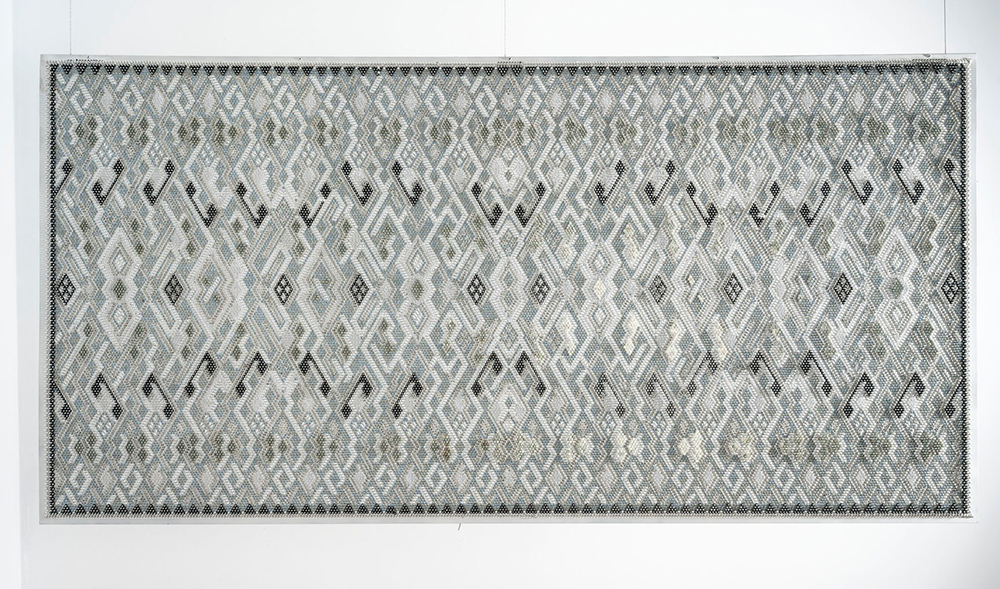
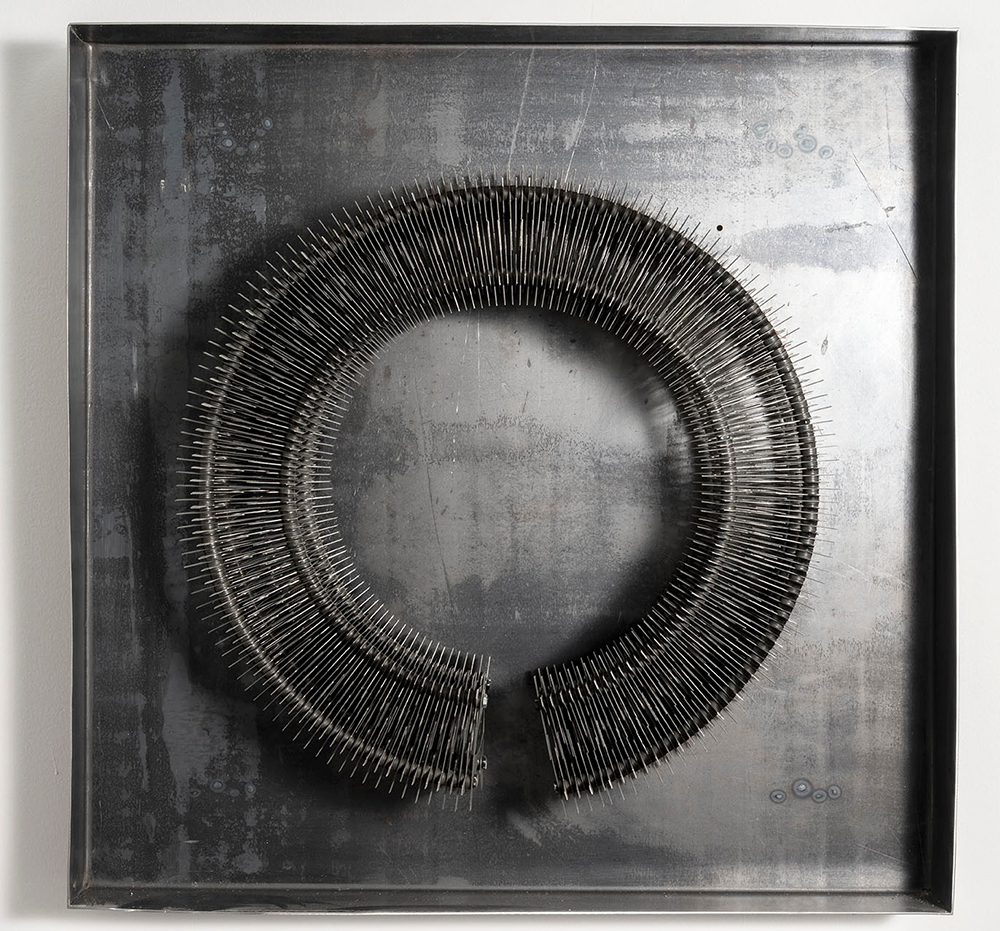
En La Balsa, Claudia Hakim presenta El universo de lo múltiple, su primera muestra individual en más de quince años. Lo que atraviesa la exposición es su manera de entender el material. Hakim no trabaja el metal como uno esperaría: lo teje. A partir de repetir, ensamblar y entrelazar piezas, construye estructuras que cambian según cómo las mires, donde lo pesado puede sentirse ligero y lo industrial, casi orgánico. Más que hablar de reciclaje, su trabajo se mueve hacia la transformación. Cada pieza juega con esa distancia entre lo que vemos y lo que realmente es, invitando a acercarse, a dudar un poco y a mirar otra vez. Hablamos con Hakim para tener una mirada más cercana a su exposición y el proceso detrás:
At La Balsa, Claudia Hakim presents El universo de lo múltiple, her first solo exhibition in over fifteen years. What runs through the show is her way of understanding material. Hakim doesn’t work with metal in the way one might expect—she weaves it. Through repetition, assembling, and interlacing pieces, she builds structures that shift depending on how you look at them, where what is heavy can feel light, and what is industrial becomes almost organic. Rather than focusing on recycling, her work moves toward transformation. Each piece plays with the distance between what we see and what is actually there, inviting us to come closer, to question, and to look again. We spoke with Claudia Hakim to get a closer look at her exhibition and the process behind it:
¿Sientes que el textil es más una forma de pensar que una técnica? ¿Cómo aparece eso en tus decisiones durante el proceso?
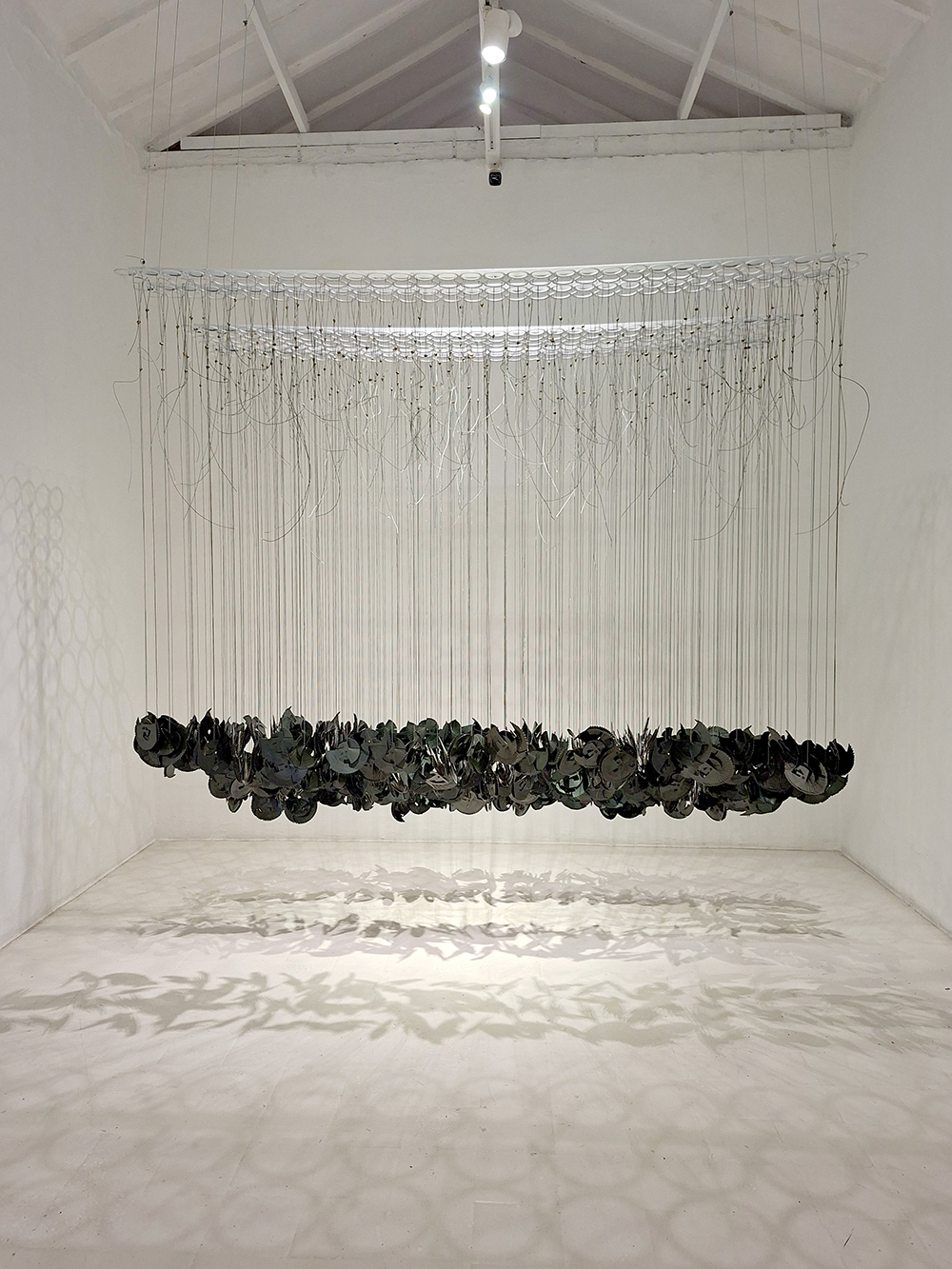
Más que una técnica, el textil es una estructura de pensamiento. Es una manera de entender el material, la relación, y la relación con la futura obra. Esa lógica permanece incluso cuando el material cambia: el paso de la fibra al metal no implica una ruptura, sino una expansión, y una nueva dimension. Trabajo como quien teje, con ritmo, y con patrones. Pienso en términos de tramas, de módulos, que se construyen o se repiten progresivamente. Cuando trabajo los metales rígidos que recojo, o los industriales, como las mallas y la tornillería los abordo desde una lógica textil: cómo se articulan, se entrelazan, cómo se sostienen entre sí, cómo generan superficie y volumen al mismo tiempo. Es una forma de construir desde la independencia, de ir ensamblando cada elemento, la acumulación, la saturación y la repetición del elemento, van generando la obra.
Do you feel that textiles are more a way of thinking than a technique? How does that appear in your decisions during the process?
More than a technique, textiles are a structure of thought. It’s a way of understanding material, relationships, and the relationship with the future work. That logic remains even when the material changes: the shift from fiber to metal is not a rupture, but an expansion—a new dimension. I work like someone weaving, with rhythm and with patterns. I think in terms of weaves, of modules that are built or progressively repeated. When I work with rigid metals that I collect, or industrial ones such as meshes and screws, I approach them through a textile logic: how they connect, interlace, how they support one another, how they generate surface and volume at the same time. It’s a way of building through independence—assembling each element so that accumulation, saturation, and repetition generate the work.
En tus piezas hay una tensión interesante entre lo que vemos y lo que realmente es el material… ¿Qué te interesa provocar en el espectador?
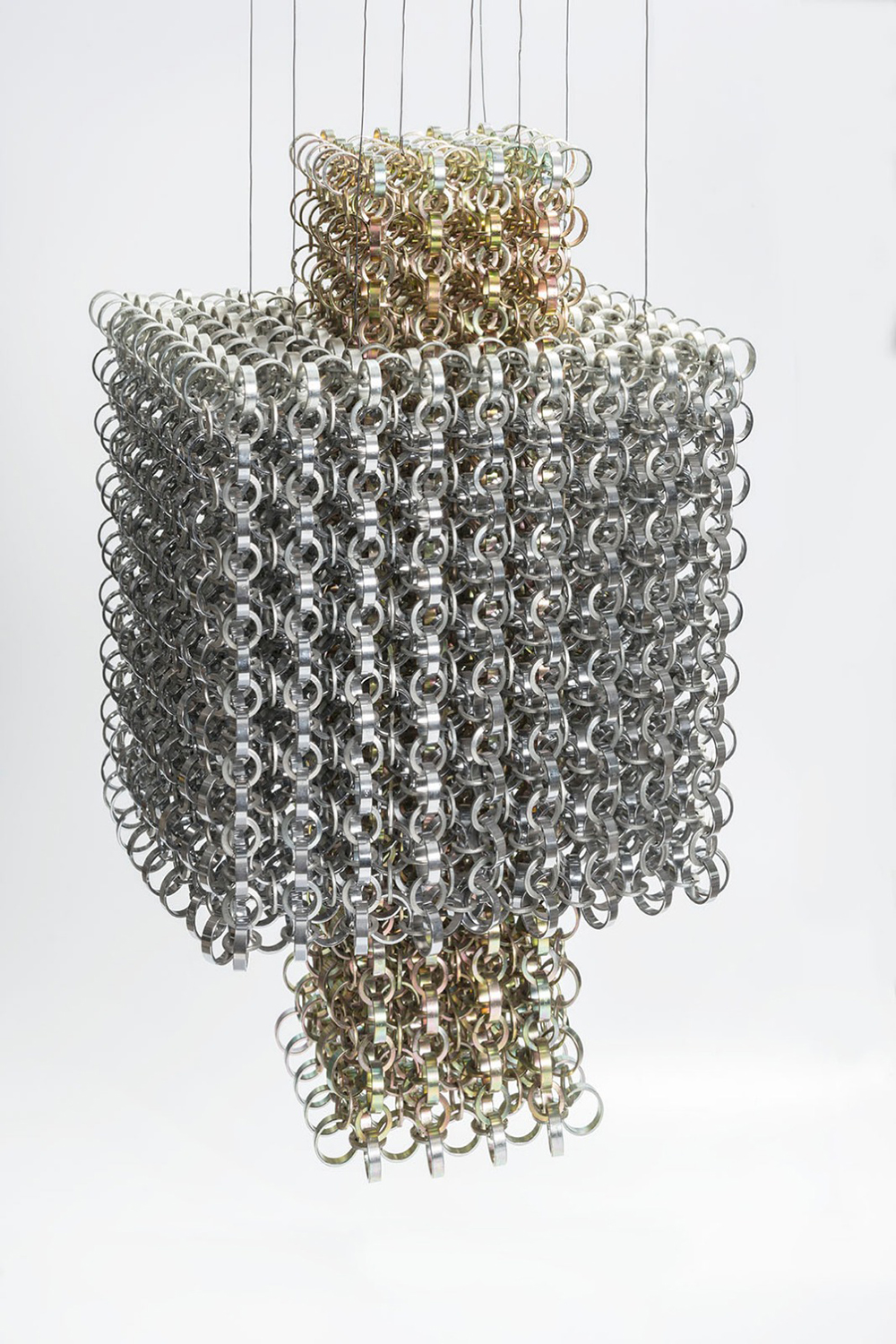
Me interesa activar ese instante en que al ver la obra el ojo duda, y el espectador no puede resolver en esa primera mirada, de que está hecha la pieza, y tenga que recorrerla, que haya un desplazamiento alrededor de ella, la habite, esa ambigüedad abre un espacio de atención más prolongado. Cuando su estructura pesada, el entrelazado o entretejido de argollas, se percibe como ligero o blanda, que se vuelve casi orgánica, se produce una especie de curiosidad, una necesidad de tocarla de sentir la obra, de moverla; ese momento es importante para mí, pues busco eso en el espectador, desestabilizar la mirada y certeza del material, (el metal). El espectador cambia su percepción, entre lo que parece y lo que es, y entra en una relación más consciente con la materia, el peso, y la escala.
In your pieces there is an interesting tension between what we see and what the material actually is… What are you interested in provoking in the viewer?
I’m interested in activating that moment when, upon seeing the work, the eye hesitates—when the viewer cannot immediately resolve what the piece is made of and has to move around it, inhabit it. That ambiguity opens up a more sustained space of attention. When its heavy structure—the interlacing or weaving of rings—is perceived as light or soft, almost organic, it creates a kind of curiosity, a desire to touch it, to feel the work, to move it. That moment is important to me, because I aim to destabilize the viewer’s perception and certainty of the material (metal). The viewer shifts between what it seems to be and what it is, entering a more conscious relationship with matter, weight, and scale.
Más allá del reciclaje… ¿te interesa más la historia del material o lo que puede llegar a ser?
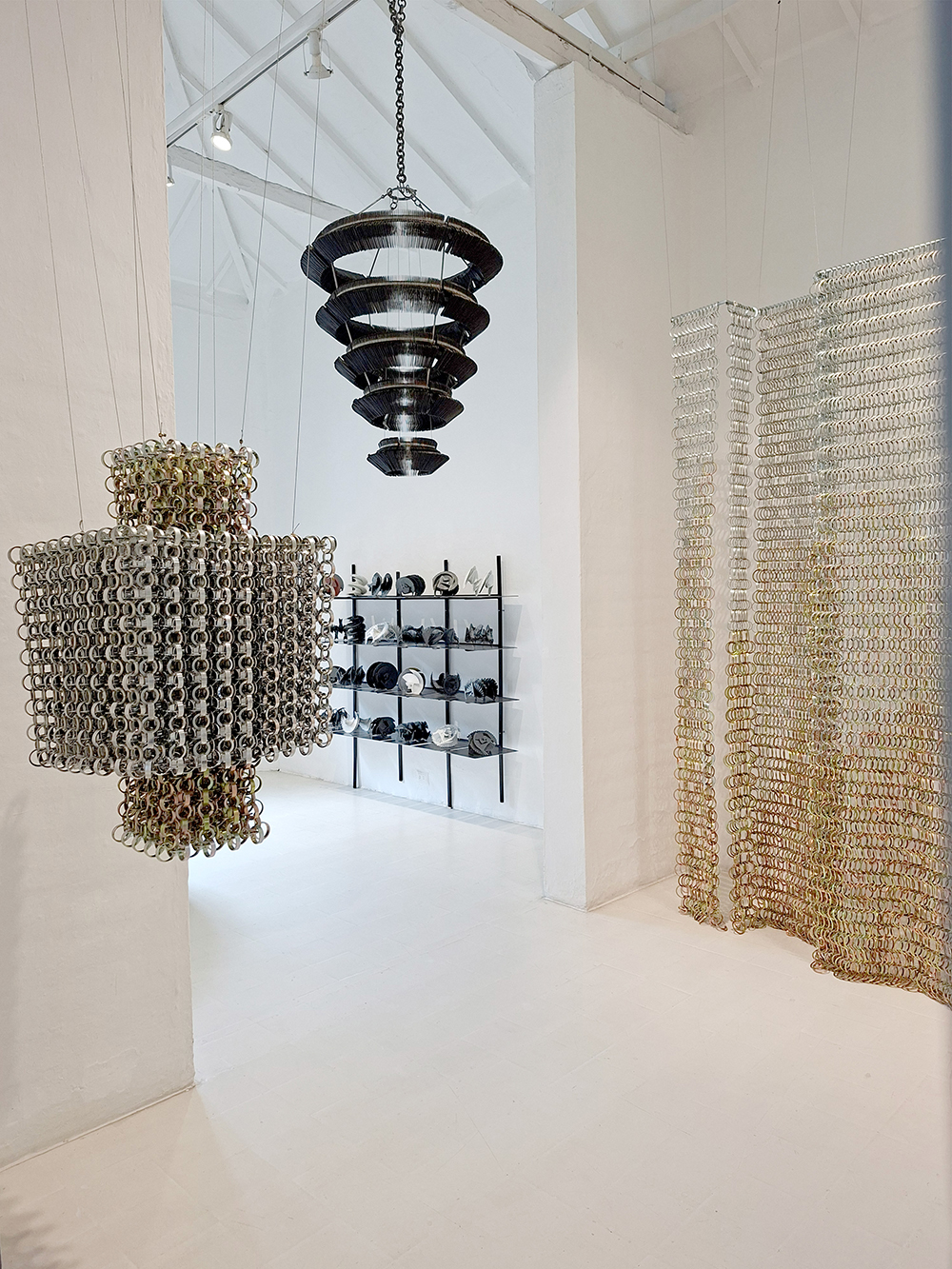
Trabajo con desechos de la industria automotriz, embragues, aros que salen de los rines, piezas diseñadas para la fricción, la velocidad y el desgaste. Llegan a mí marcadas por esa experiencia: contienen una memoria de fuerza, de tensión acumulada, de movimiento detenido, cuando lo selecciono de las canecas que tienen otro rumbo. Esa historia me importa, pero no como un relato cerrado ni nostálgico. Lo que me interesa es activar su posibilidad de transformación, de darles una segunda oportunidad, de abrir la imaginación, les altero su función, su escala y su lectura. Me interesa justamente ese umbral: donde lo industrial y lo orgánico, lo residual y lo vital, coexisten sin anularse. Allí es donde la materia encuentra otra vida posible.
“Estas obras nos recuerdan que nada está condenado al silencio: todo material guarda un potencial latente, esperando la mirada que lo transforme en arte y en símbolo de futuro. En estas esculturas, el acero industrial deja de ser residuo para convertirse en forma, memoria y posibilidad. Estos elementos son parte de desechos de la industria automotriz, aros de rines, embragues y piezas modulares, que se transforman en cuerpos que oscilan entre lo funcional y lo poético. Cada elemento, antes destinado al desgaste y al olvido, encuentra aquí una segunda vida. Al ensamblarlos con creatividad y rigor, resignificamos su carga material y simbólica: de objetos industriales, nacen esculturas que invitan a repensar el ciclo de uso, descarte y transformación. La obra no solo habla de reciclaje, sino de la capacidad del arte para imaginar futuros sostenibles. Allí donde el consumo genera exceso, el arte encuentra sentido; allí donde hubo residuo, surge belleza. Estos fragmentos de memoria mecánica que al entrelazarlos, se transforman, en formas que dialogan con la luz, la textura, y el espacio. Lo que alguna vez fue residuo se convierte en poesía tangible, en gesto de renovación. En esta serie, el diseño se convierte en lenguaje: de la reiteración surgen volúmenes distintos, esculturas que muestran cómo lo idéntico puede transformarse en múltiples expresiones. Lo que parecía limitado se expande en creatividad, revelando la riqueza de lo modular y el poder del arte para reinventar lo cotidiano”. — El universo de lo múltiple
Beyond recycling… are you more interested in the history of the material or in what it can become?
I work with waste from the automotive industry—clutches, rings from rims, pieces designed for friction, speed, and wear. They come to me marked by that experience: they carry a memory of force, accumulated tension, and suspended movement, when I select them from containers where they were headed toward another fate. That history matters to me, but not as a closed or nostalgic narrative. What interests me is activating their potential for transformation—giving them a second chance, opening up imagination. I alter their function, their scale, and their reading. I’m interested precisely in that threshold where the industrial and the organic, the residual and the vital, coexist without canceling each other out. That is where matter finds another possible life.
“These works remind us that nothing is condemned to silence: every material holds a latent potential, waiting for the gaze that transforms it into art and into a symbol of the future. In these sculptures, industrial steel ceases to be waste and becomes form, memory, and possibility. These elements—automotive debris such as rim rings, clutches, and modular pieces—are transformed into bodies that oscillate between the functional and the poetic. Each element, once destined for wear and oblivion, finds a second life here. By assembling them with creativity and rigor, we re-signify their material and symbolic weight: from industrial objects emerge sculptures that invite us to rethink cycles of use, disposal, and transformation. The work does not speak only of recycling, but of art’s capacity to imagine sustainable futures. Where consumption produces excess, art finds meaning; where there was waste, beauty emerges. These fragments of mechanical memory, once interwoven, transform into forms that dialogue with light, texture, and space. What was once residue becomes tangible poetry, a gesture of renewal. In this series, design becomes language: from repetition emerge distinct volumes, sculptures that show how the identical can transform into multiple expressions. What seemed limited expands into creativity, revealing the richness of the modular and the power of art to reinvent the everyday.” — The universe of the multiple
Después de más de quince años sin una muestra individual, ¿como fue para ti volver a hacer visible tu obra? ¿Respondió mas a un momento personal o a una necesidad del propio trabajo?
“En el campo del arte contemporáneo colombiano, la trayectoria de Claudia Hakim se distingue por una paradoja singular: la de una artista de extraordinaria sofisticación formal cuya obra ha permanecido, durante largos períodos, en una esfera de discreción voluntaria. Dedicada intensamente a su labor como gestora cultural de NC-Arte y como directora del MAMBO, Hakim ha postergado reiteradamente la visibilidad de su propia producción. Tal vez por un pudor injustificado, tal vez por la exigencia ética que impone a su práctica, su trabajo ha aparecido de manera esporádica, pese a contar con más de treinta años de trayectoria”. — Eugenio Viola
Volver a hacer visible la obra fue un proceso muy emocionante. No respondió únicamente a un momento personal, sino a una necesidad interna que estaba deseando cumplir. Había una acumulación de procesos, de exploraciones con materiales que requerían un espacio propio de articulación, y en la galería La Balsa, Medellín, encontró su momento de visibilidad. En ese sentido, la muestra no es un punto de partida, sino un momento para mi, muy importante, dentro de un proceso que sigue en desarrollo. La obra nunca dejó de hacerse, ahora le dedico mas tiempo, y la trabajo con mas seguridad, pues ya empieza a encontrar su lugar en la mirada de otros.
After more than fifteen years without a solo exhibition, what was it like for you to make your work visible again? Was it more a personal moment or a necessity of the work itself?
“In the field of Colombian contemporary art, Claudia Hakim’s trajectory is marked by a singular paradox: that of an artist of extraordinary formal sophistication whose work has, for long periods, remained within a sphere of voluntary discretion. Deeply committed to her work as a cultural manager at NC-Arte and as director of MAMBO, Hakim has repeatedly postponed the visibility of her own production. Perhaps out of an unjustified modesty, perhaps due to the ethical demands she places on her practice, her work has appeared only sporadically, despite spanning more than thirty years.” — Eugenio Viola
Making the work visible again was a very emotional process. It did not respond solely to a personal moment, but to an internal necessity that had long been waiting to be fulfilled. There was an accumulation of processes and material explorations that required their own space for articulation—and at La Balsa gallery in Medellín, that moment of visibility emerged. In that sense, the exhibition is not a starting point, but a very important moment within an ongoing process. The work never stopped being made; now I dedicate more time to it and approach it with greater confidence, as it begins to find its place in the gaze of others.
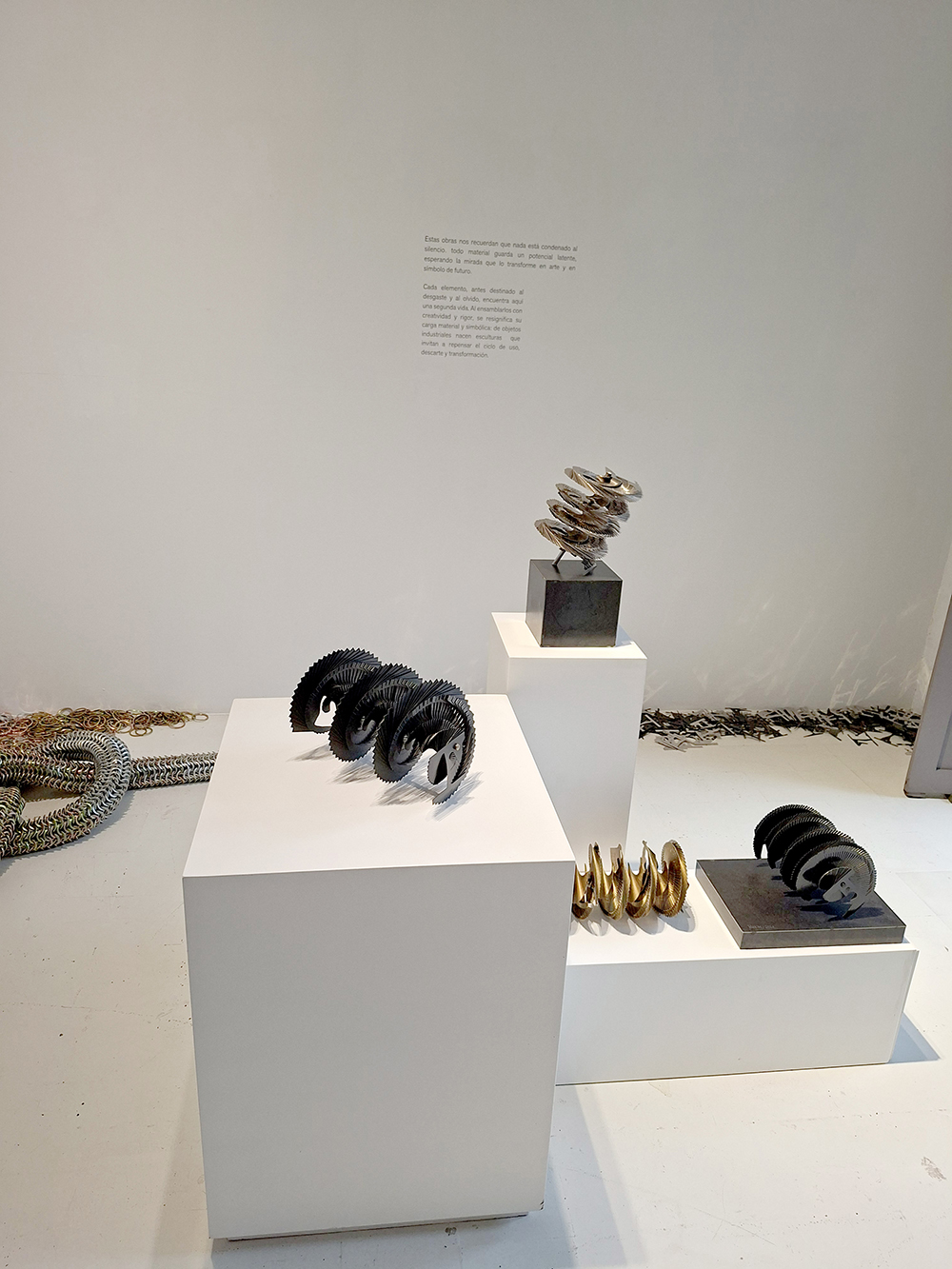
Más que ofrecer respuestas cerradas, la obra de Claudia Hakim propone una forma distinta de mirar: más atenta, más paciente, más dispuesta a sostener la duda. En ese gesto, se abre un espacio donde el material deja de ser fijo y se vuelve posibilidad. Abierto hasta el 16 de abril, 2026 en La Balsa, Medellín.
More than offering fixed answers, the work of Claudia Hakim proposes a different way of seeing—more attentive, more patient, more willing to hold uncertainty. In that gesture, a space opens up where material stops being fixed and becomes possibility. On view through April 16, 2026 at La Balsa, Medellin.