
20.11.2026. Ciudad de México
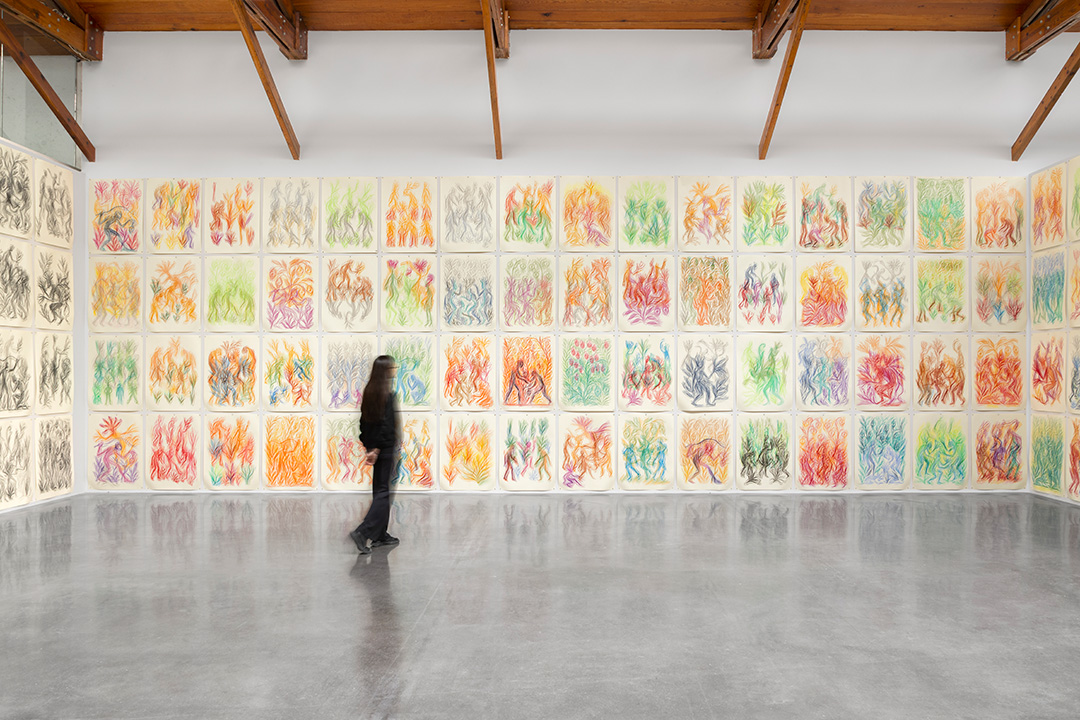
Al entrar a la sala principal de kurimanzutto, lo primero que golpea es la cantidad. Decenas de frottages cubren dos muros en retícula, uno en tonos de grafito y otro en una gama de color que parece salida de una caja de crayones escolares. En cada hoja se repite, con variaciones mínimas, una escena de cuerpos enredados con hojas y tallos. Anteparaíso, la cuarta individual de Carlos Amorales con la galería y la tercera en su sede de la Ciudad de México, toma su título del poemario que Raúl Zurita publicó en 1982 y lo cruza con dos materiales improbables, la ciencia ficción victoriana de H. G. Wells y la ansiedad actual frente a la inteligencia artificial.
El punto de partida es La guerra de los mundos, la novela de 1898 en la que Gran Bretaña, potencia colonial de la época, sufre la invasión de unos marcianos con tecnología superior. Amorales traslada esa inversión a un mundo propio, habitado por criaturas mitad humanas y mitad vegetales que trabajan la tierra y por extraterrestres que las explotan como ganado. En la pared, esa jerarquía se disuelve pronto. Las figuras bailan, se abrazan y copulan, y a cierta distancia cuesta saber quién domina a quién. Ahí está lo mejor de la instalación, en que la imagen se resiste a ilustrar su propia tesis y deja que el mestizaje aparezca como un enredo de líneas antes que como un discurso.
Upon entering the main gallery at kurimanzutto, the first thing that strikes you is the sheer quantity. Dozens of frottages cover two walls in a grid: one in graphite tones, the other in a range of colors that seems to have come straight out of a school crayon box. Each sheet repeats, with minimal variations, a scene of bodies entangled with leaves and stems. Anteparaíso, Carlos Amorales’s fourth solo exhibition with the gallery and his third at its Mexico City space, takes its title from the poetry collection published by Raúl Zurita in 1982, bringing it into dialogue with two unlikely references: the Victorian science fiction of H. G. Wells and contemporary anxieties surrounding artificial intelligence.
The starting point is The War of the Worlds, the 1898 novel in which Great Britain, then a colonial power, is invaded by Martians equipped with superior technology. Amorales transposes this reversal into a world of his own, inhabited by half-human, half-plant creatures who work the land and by extraterrestrials who exploit them as livestock. On the wall, however, this hierarchy quickly dissolves. The figures dance, embrace, and copulate, and from a certain distance it becomes difficult to tell who dominates whom. This is where the installation is at its best: the images resist illustrating their own thesis, allowing hybridity to emerge as a tangle of lines rather than a statement.
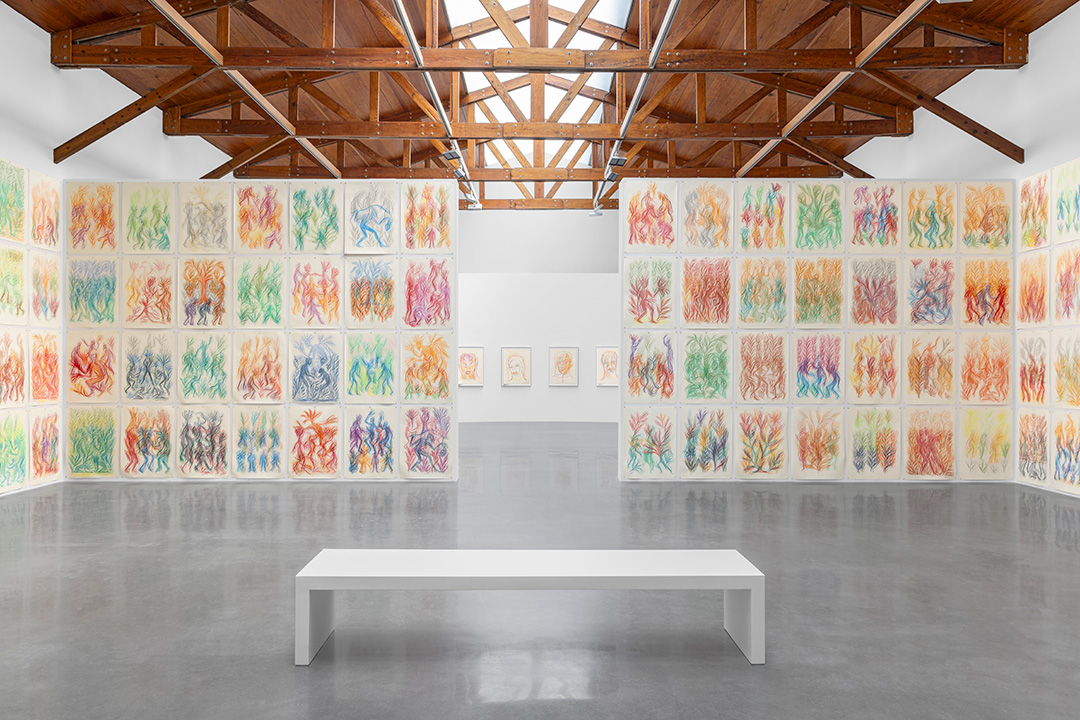
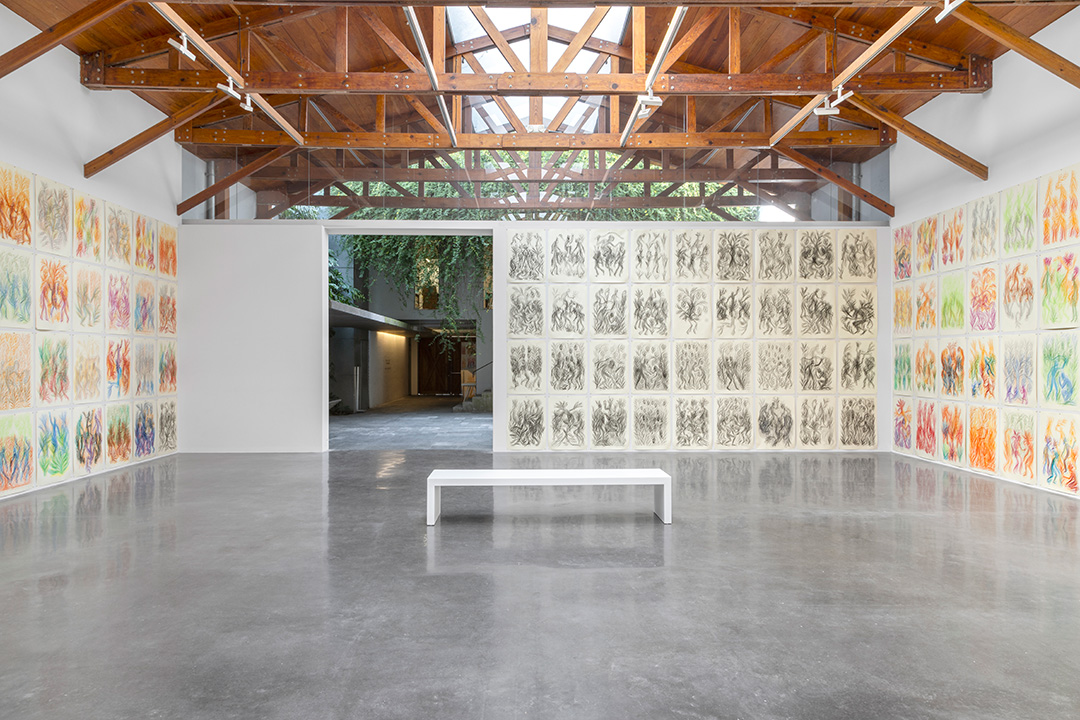
La técnica sostiene esa ambigüedad. Amorales genera patrones con un programa de inteligencia artificial, los recorta como plantillas, los pone debajo del papel y frota encima con crayones de cera de abeja hechos para niños, los mismos que usa la pedagogía antroposófica a partir de la teoría del color de Goethe. La imagen de la máquina pasa así por un gesto casi infantil, repetitivo y táctil, dondel trazo sale vibrando, con la textura de la plantilla marcada en la cera, y en esa pequeña imperfección se nota la mano. El procedimiento prolonga una búsqueda que Amorales mantiene desde Archivo Líquido, el repertorio de formas que inició en 1998, en torno a cómo un signo cambia al pasar de un sistema a otro.
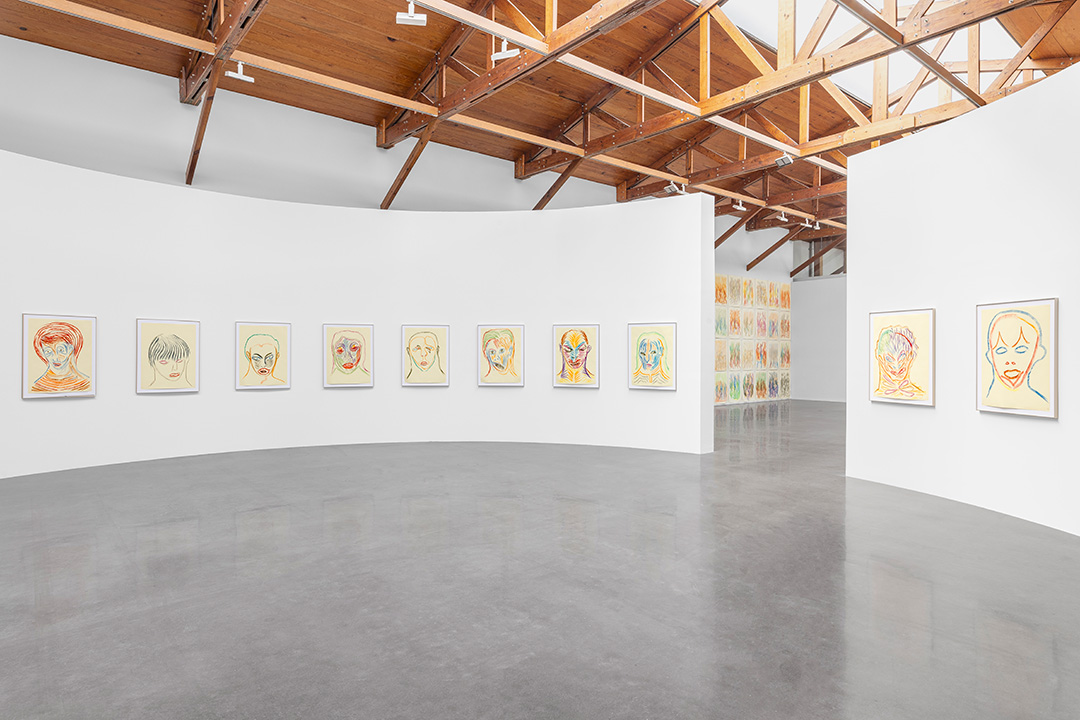
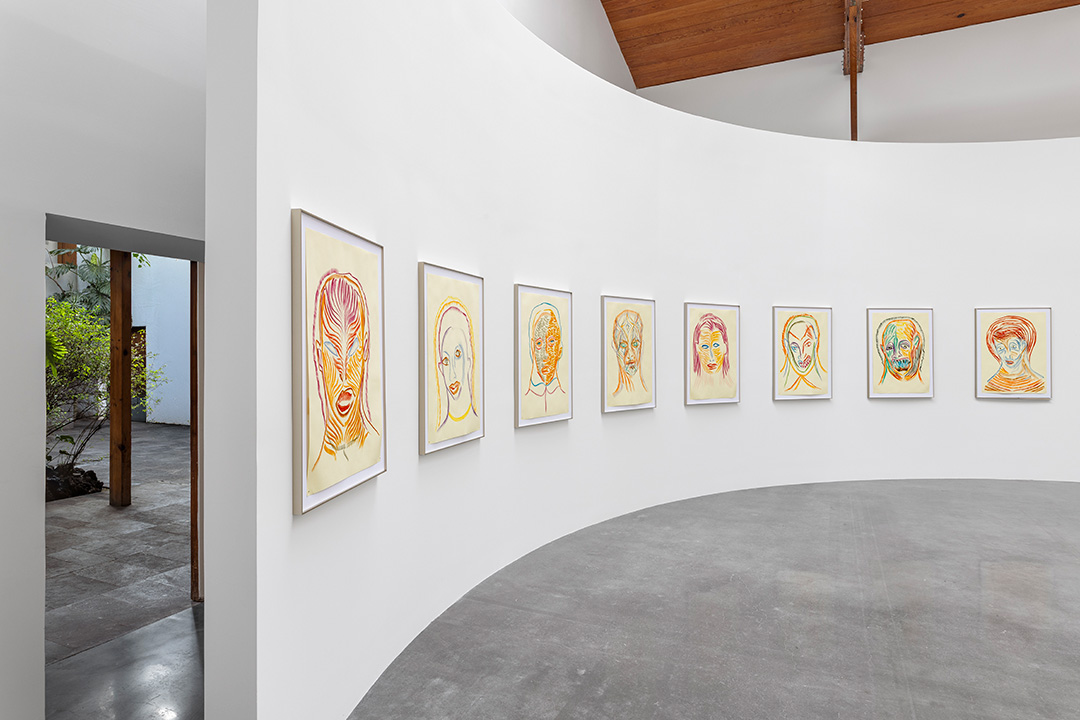
En la segunda sala, un muro curvo sostiene la serie ThisPersonDoesNotExist, una hilera de rostros enmarcados a la altura de los ojos. El título remite al sitio web que genera retratos fotorrealistas de personas inexistentes a partir de enormes bancos de caras, los mismos que alimentan los sistemas de reconocimiento facial, mientras que los rostros de Amorales salen de su imaginación y están dibujados a mano con la misma cera, con bocas abiertas, ojos cansados y pieles rayadas como cortezas. El montaje circular recuerda al panóptico de Jeremy Bentham, y que retoma Foucault más adelante; la prisión donde un vigilante en el centro puede verlo todo sin ser visto, solo que aquí el dispositivo funciona al revés y es el visitante quien queda en medio, rodeado de caras que lo miran desde todas partes, hasta que deja de ser quien observa para sentirse observado. Esa sensación nos acompaña a diario sin que la notemos, en las cámaras de la calle o en el teléfono que se desbloquea al reconocer nuestra cara, y en la sala se vuelve de pronto visible, aunque venga de rostros que no existen y que, aun así, cuesta dejar de sentir encima.
The technique sustains this ambiguity. Amorales generates patterns using an artificial intelligence program, cuts them into stencils, places them beneath the paper, and rubs over them with beeswax crayons designed for children, the same kind used in Waldorf education, which draws on Goethe’s theory of color. The machine-generated image thus passes through an almost childlike gesture, one that is repetitive and tactile. The resulting lines vibrate across the surface, with the texture of the stencil impressed into the wax. In these small imperfections, the artist’s hand becomes visible. The process extends an ongoing investigation that Amorales has pursued since Liquid Archive, the repertoire of forms he began developing in 1998, exploring how a sign changes as it moves from one system to another.
In the second room, a curved wall holds the series ThisPersonDoesNotExist, a row of framed faces positioned at eye level. The title refers to the website that generates photorealistic portraits of nonexistent people using vast databases of faces, the same kind of data that feeds facial recognition systems. Amorales’s faces, by contrast, emerge from his imagination and are drawn by hand in the same wax medium, with open mouths, tired eyes, and skin marked by lines resembling tree bark. The circular installation recalls Jeremy Bentham’s panopticon, later revisited by Foucault: a prison in which a guard positioned at the center can see everything without being seen. Here, however, the mechanism works in reverse. The visitor occupies the center, surrounded by faces looking in from every direction, until they cease to be the observer and begin to feel observed. This sensation accompanies us daily, often unnoticed, through street surveillance cameras or the phone that unlocks itself by recognizing our face. In the gallery, it suddenly becomes visible, even if it comes from faces that do not exist and that, somehow, are difficult to stop feeling under their gaze.
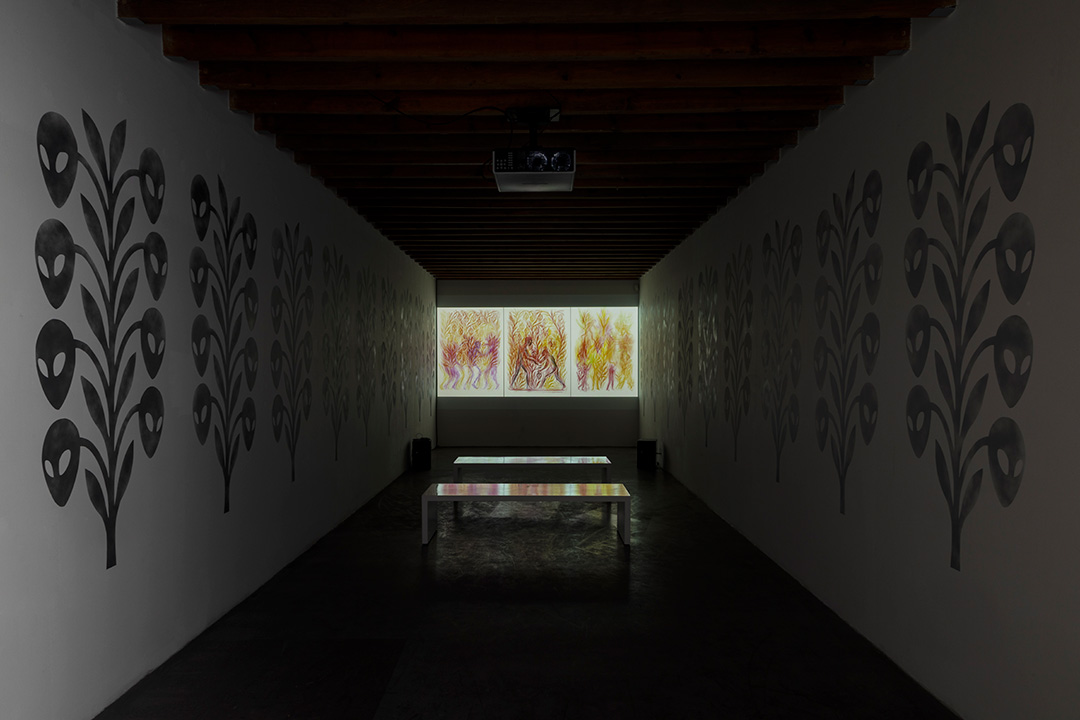
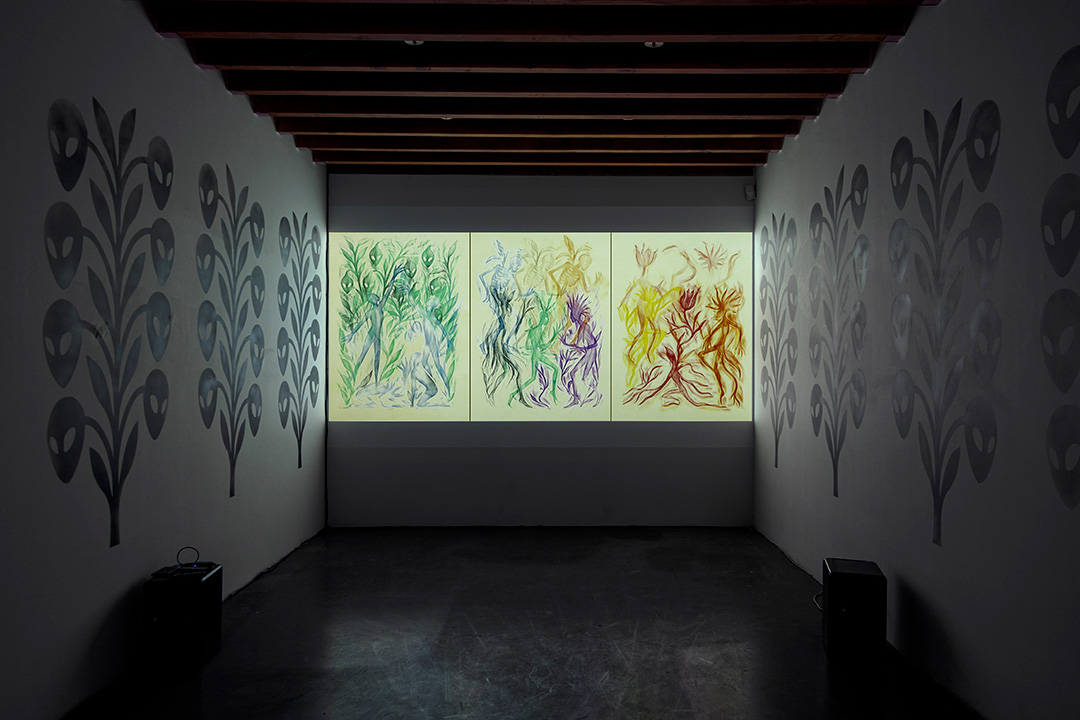
Esa contaminación regresa en el Project Room con Paraíso, un tríptico animado a partir de los dibujos de la sala principal. El cuarto está a oscuras y en los muros laterales crecen unas plantas grises cuyos brotes son cabezas de alienígen;. al fondo, las tres escenas se mueven apenas, siguiendo un prompt que pide una coreografía de labores agrícolas inspirada en el butoh. La referencia a El jardín de las delicias de El Bosco está en el formato y en la población de cuerpos, aunque aquí falta el juicio moral y nadie termina en el infierno. Con la música ambiental de Daniela Huerta, el trabajo del campo y la danza ritual se vuelven un mismo gesto lento. El círculo se cierra de manera elegante. Lo que empezó como imagen algorítmica, pasó por la mano y la cera, vuelve a la máquina para respirar.
Zurita escribió Anteparaíso en medio de la dictadura chilena, pensando en un lugar anterior a cualquier promesa. Amorales toma la palabra con más ligereza y la usa para nombrar un presente suspendido, donde la tecnología todavía puede leerse como salvación o como catástrofe. La exposición prefiere quedarse en ese umbral, y lo habita con un colorido y un humor que pocas muestras sobre inteligencia artificial se permiten.
This contamination returns in the Project Room with Paraíso, a triptych of animations based on the drawings in the main gallery. The room is dark, and gray plants grow across the side walls, their shoots crowned with alien heads. At the back, three scenes move almost imperceptibly, following a prompt that calls for a choreography of agricultural labor inspired by butoh. The reference to Hieronymus Bosch’s The Garden of Earthly Delights lies in the format and the multitude of bodies, although the moral judgment is absent here, and no one ends up in hell. Accompanied by Daniela Huerta’s ambient soundtrack, agricultural work and ritual dance become a single, slow-moving gesture. The circle closes elegantly. What began as an algorithmic image, passed through the hand and the wax, returns to the machine to breathe.
Zurita wrote Anteparaíso amid the Chilean dictatorship, imagining a place that precedes any promise. Amorales approaches the word more lightly, using it to name a suspended present in which technology can still be understood as either salvation or catastrophe. The exhibition chooses to remain at this threshold, inhabiting it with a sense of color and humor that few exhibitions about artificial intelligence allow themselves.
Anteparaíso puede visitarse hasta el 16 de diciembre de 2026 en kurimanzutto, colonia San Miguel Chapultepec, Ciudad de México.
Anteparaíso is on view through December 16, 2026, at kurimanzutto, in the San Miguel Chapultepec neighborhood of Mexico City.