
12.10.2026. Bogotá
Astrid Svangren llegó a Bogotá con una práctica acostumbrada a hacer que la pintura se salga de sus buenos modales. Nacida en Gotemburgo en 1972 y formada en Malmö, la artista sueca ha desarrollado durante décadas un lenguaje donde el cuadro puede convertirse en red, tul, celofán, cabello, volumen, sombra o presencia suspendida. Sus instalaciones trabajan desde la asociación, la acumulación y el encuentro entre materiales que parecen estar resolviendo una conversación propia.
Durante un mes de residencia en Talleres Telecom, bajo la dirección de Exclama Proyectos, Svangren llevó esa lógica al edificio. El jardín cerrado, vestido por un día con atuendos de criaturas fluidas fue tomando forma desde la escala de la sala, las ventanas, las alturas, los vacíos y las trayectorias que el cuerpo podía inventar entre una tela y otra, dejando que así lugar entrara al trabajo.
Astrid Svangren arrived in Bogotá with a practice accustomed to making painting misbehave. Born in Gothenburg in 1972 and trained in Malmö, the Swedish artist has spent decades developing a visual language in which the picture can become mesh, tulle, cellophane, hair, volume, shadow, or suspended presence. Her installations emerge through association, accumulation, and encounters between materials that seem to be carrying on a conversation of their own.
During a month-long residency at Talleres Telecom, directed by Exclama Proyectos, Svangren brought this logic into the building itself. A Closed Garden, Dressed for a Day in the Attire of Fluid Creatures gradually took shape in response to the scale of the room, its windows, heights, voids, and the paths the body could trace between one fabric and another, allowing the space itself to enter the work.
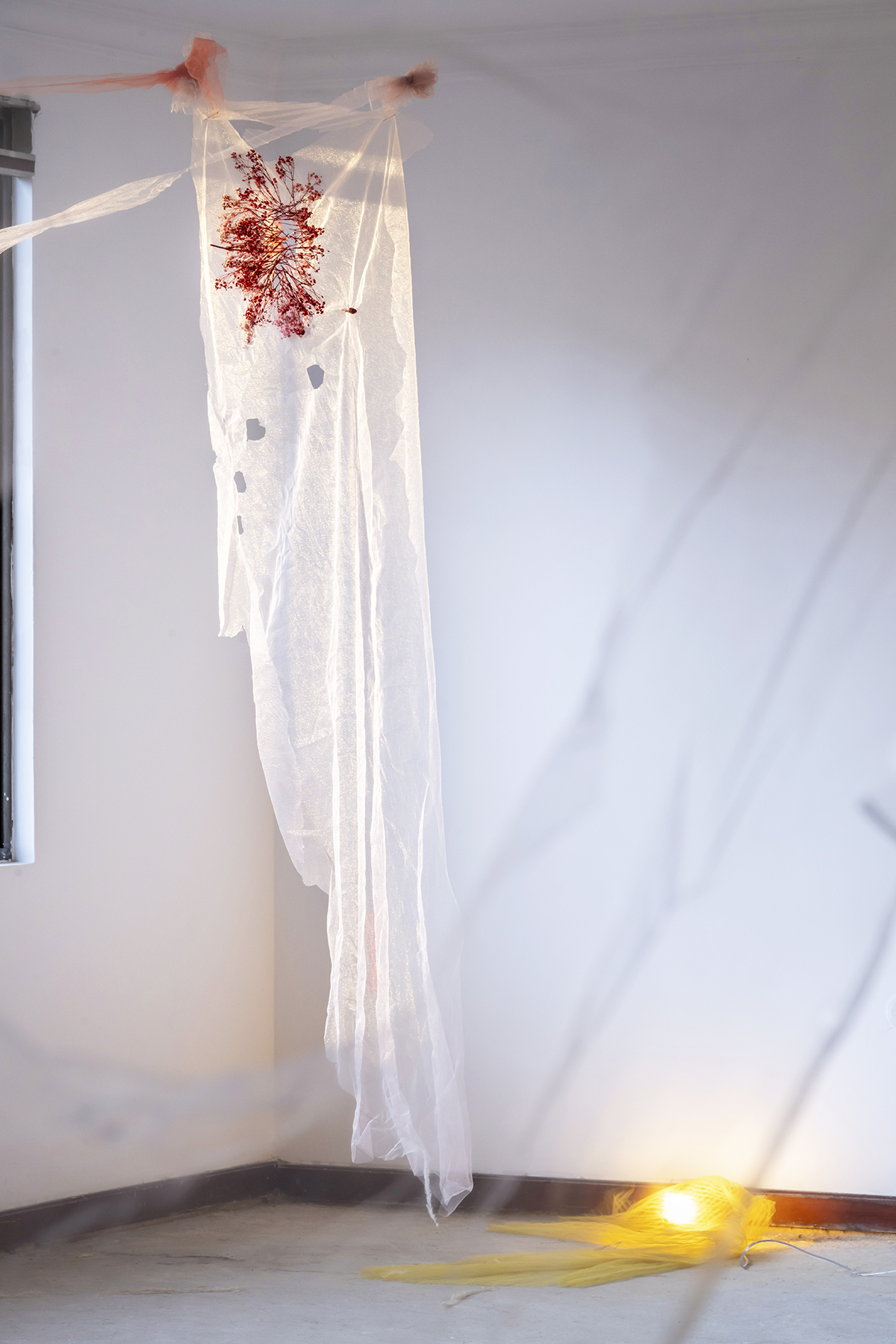
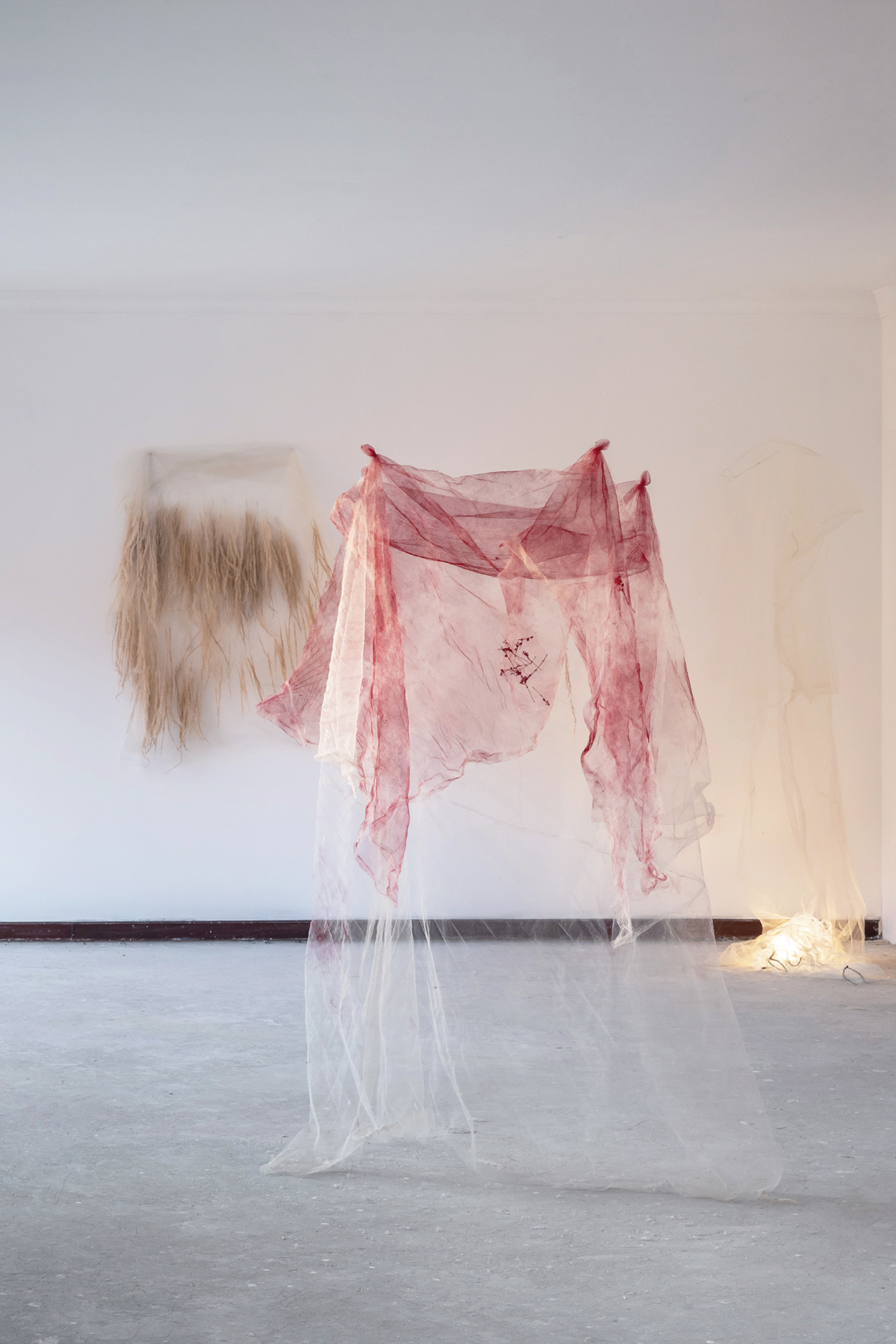
En el centro aparece una estructura de textiles translúcidos, rojos y blanquecinos, que cuelgan, se cruzan y arman un recinto dentro del recinto. Alrededor, los amarillos y rojos dispuestos sobre el suelo funcionan como focos de intensidad; en las paredes, unas figuras fibrosas prolongan esa misma sensación de materia en estado de transformación. Una gran gasa azul atraviesa otra versión del montaje como si la sala hubiera quedado atrapada bajo una capa de agua, una piel gigante o una cortina demasiado viva para limitarse a decorar.
Svangren tiene una relación bastante particular con la pintura. Le interesa su capacidad de contaminarlo todo. Es así como el color deja de pertenecer a una superficie y empieza a circular por la arquitectura. Se engancha en una esquina, se estira desde el techo, se derrama sobre el piso, se vuelve transparente o adquiere densidad. Sus materiales han incluido tul, redes de pesca, celofán, estructuras y elementos reflectantes; la artista los organiza como ensamblajes pictóricos y entidades espaciales pensadas para una percepción fragmentaria, sin centro fijo ni jerarquías claras.
At the center stands a structure of translucent textiles in red and whitish tones, hanging, intersecting, and forming an enclosure within an enclosure. Around it, yellow and red elements arranged across the floor act as points of intensity; on the walls, fibrous forms extend that same sense of matter in a state of transformation. A large blue gauze cuts through another version of the installation, as though the room had been caught beneath a layer of water, a giant skin, or a curtain too alive to serve merely as decoration.
Svangren has a distinctive relationship with painting. She is interested in its capacity to contaminate everything it touches. Color thus ceases to belong to a single surface and begins to circulate through the architecture. It catches on a corner, stretches down from the ceiling, spills across the floor, becomes transparent or acquires density. Her materials have included tulle, fishing nets, cellophane, structures, and reflective elements, which she arranges into painterly assemblages and spatial entities designed for a fragmented mode of perception, without a fixed center or clear hierarchy.
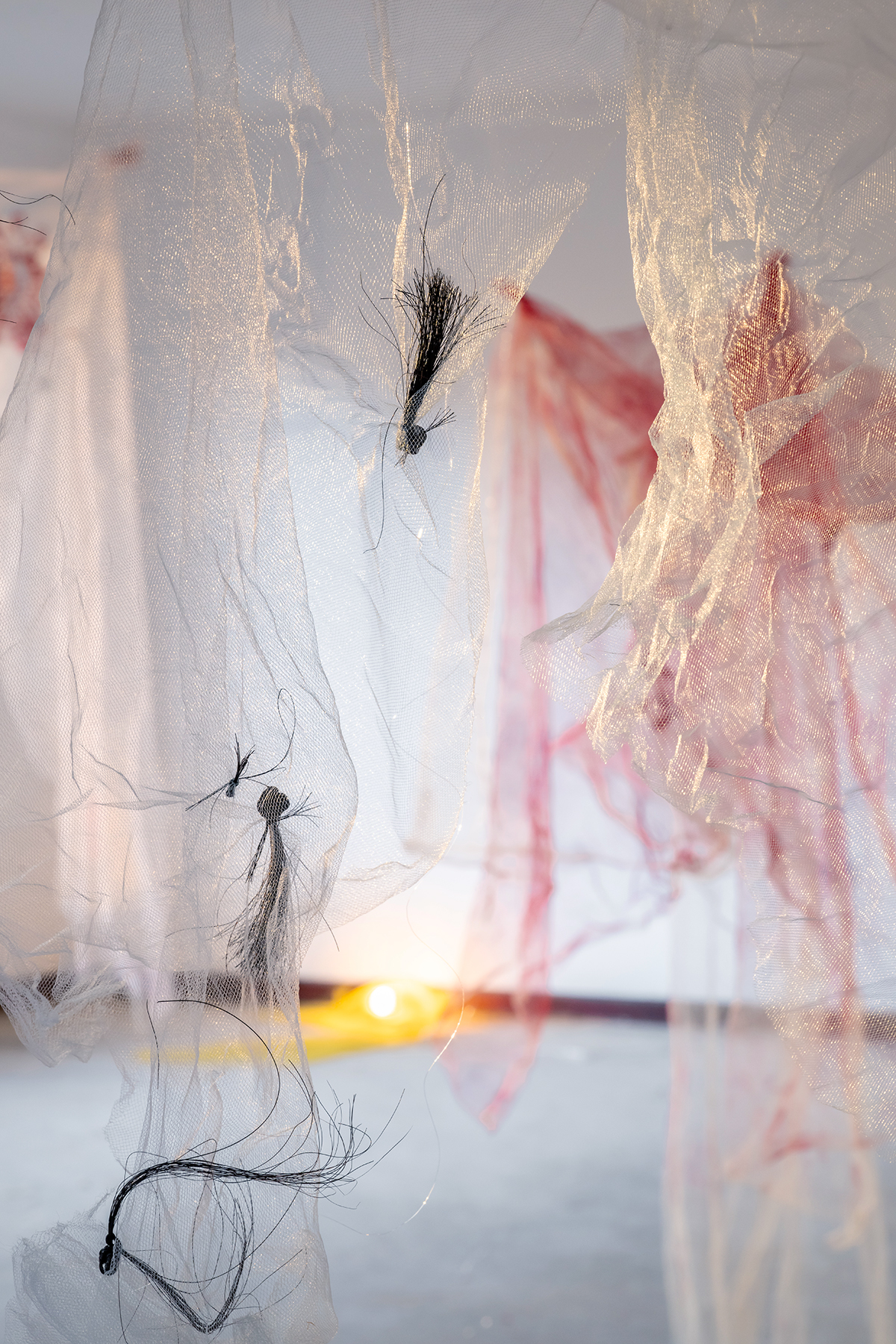
En Talleres Telecom, esa forma de trabajar encuentra una escala generosa. La obra pide ser recorrida y mirada desde varios ángulos. A ratos la sala se deja ver completa; a ratos queda atravesada por filtros, hebras, velos y transparencias. La exposición cambia según la distancia; de lejos, aparecen campos de color; de cerca, surgen nudos, tensiones, bordes, rastros del montaje y pequeñas decisiones que sostienen la escena.
El título carga una pista importante. Hay un jardín, pero sus flores fueron reemplazadas por criaturas y por los atuendos de criaturas que podrían pertenecer a cualquier especie. Svangren lleva tiempo creando mundos donde las figuras humanas, animales, objetos y materiales circulan sin respetar demasiado las divisiones habituales. Sus obras han sido leídas como escenarios poblados por personajes, formas y presencias que comparten el mismo plano, sin que una domine del todo a la otra.
At Talleres Telecom, this way of working finds room to unfold. The work invites visitors to move through it and look at it from different angles. At times, the room reveals itself in its entirety; at others, it is crossed by filters, threads, veils, and transparencies. The exhibition shifts with distance: from afar, fields of color emerge; up close, knots, tensions, edges, traces of the installation process, and the small decisions that hold the scene together come into view.
The title offers an important clue. There is a garden, but its flowers have been replaced by creatures and by the garments of creatures that might belong to any species. Svangren has long been creating worlds in which human figures, animals, objects, and materials move freely, with little regard for conventional divisions. Her works have been understood as settings populated by characters, forms, and presences that share the same plane, none entirely dominating the others.
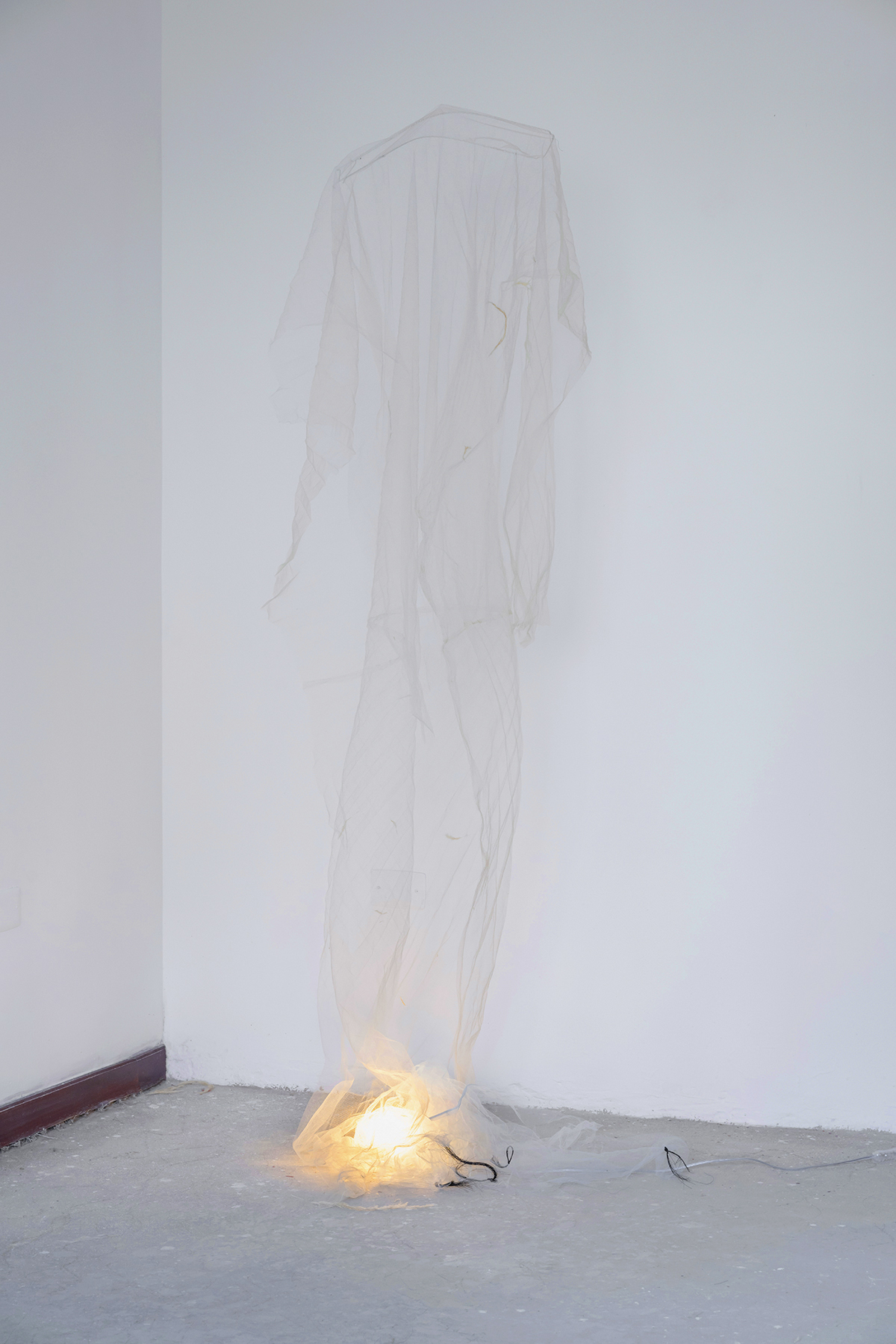
Acá, el textil funciona como vestido, abrigo, piel y resto. También como una forma de probar otra manera de estar. Hay algo muy libre en esa operación de poner una red, extender una membrana sobre una ventana, colgar una fibra roja de una pared, dejar que una trama cubra parcialmente el campo visual. Por eso, el jardín cerrado no se siente como un espacio clausurado. Tiene más bien la intimidad de un cuarto donde algo está pasando fuera de la vista de los demás. Un lugar para juntar colores, dejar caer telas, cambiar de piel, inventar una presencia y ver qué ocurre cuando la pintura decide abandonar el cuadro.
La residencia permitió que la exposición conservara el ritmo de un proceso, una cualidad muy cercana al trabajo de Svangren. En sus propias palabras, recrear, reorganizar y reutilizar forma parte de un hacer en el que todo se entrelaza, sin principio ni final, siempre en movimiento. Esa idea atraviesa la muestra sin volverse solemne. Se siente en la disposición de los materiales, en los momentos de aparente desorden, en las relaciones inesperadas entre un velo, una luz desde el piso y una mancha de color.
Here, textile functions as dress, shelter, skin, and remnant. It also becomes a way of testing another mode of being. There is something deeply liberating about placing a net, stretching a membrane across a window, hanging a red fiber from a wall, or allowing a weave to partially obscure the field of vision. For this reason, the closed garden does not feel like a sealed-off space. Instead, it has the intimacy of a room where something is happening beyond the sight of others. A place to gather colors, let fabrics fall, change skins, invent a presence, and see what happens when painting decides to leave the picture behind.
The residency allowed the exhibition to retain the rhythm of a process, a quality closely aligned with Svangren’s practice. In her own words, recreating, rearranging, and reusing are part of a way of working in which everything intertwines, without beginning or end, always in motion. This idea runs through the exhibition without becoming solemn. It can be felt in the arrangement of the materials, in moments of apparent disorder, and in the unexpected relationships between a veil, light rising from the floor, and a patch of color.
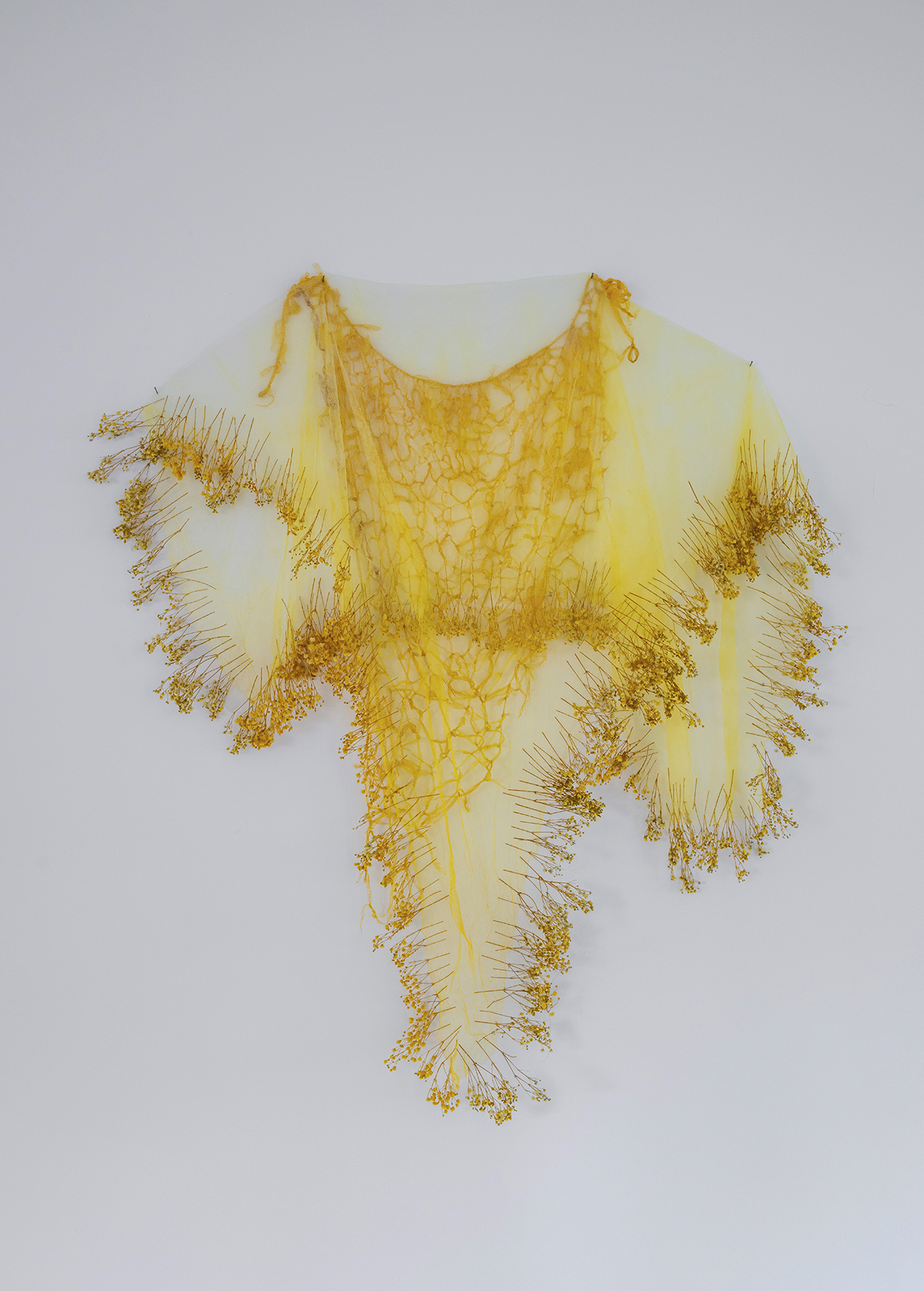
Astrid Svangren convirtió Talleres Telecom en una pintura expandida y extrañamente hospitalaria. Una sala para entrar sin buscar una lectura única, dejarse llevar por las capas y aceptar que, por un momento, la arquitectura de paredes blancas también puede vestirse de criatura.
La artista estuvo en residencia en Talleres Telecom del 1 al 30 de septiembre de 2026, como parte de un programa organizado por EXCLAMA Proyectos.
Astrid Svangren transformed Talleres Telecom into an expanded and strangely hospitable painting: a room to enter without searching for a single interpretation, to be carried along by its layers, and to accept that, for a moment, the architecture of white walls can also dress itself as a creature.
The artist was in residence at Talleres Telecom from September 1 to 30, 2026, as part of a residency organized by EXCLAMA Proyectos.